CHALLENGE
Samer Forzley, Marketing VP, eBillme, needed to create an advantage for the online-shopping brand over its two more established competitors. Previously, when they sought to add more online options for shoppers who prefer paying by cash through their banks, Forzley and his team targeted eretail sites.
For this campaign, they decided to target shoppers instead. They hoped to create a groundswell of recognition among online consumers and encourage eretail prospects to follow them to eBillme’s door. “We needed to do better in terms of bolstering awareness among consumers,” Forzley says. “And we really hadn’t done anything in the social media world up to that point.”
CAMPAIGN
To make shoppers more familiar with the site, Forzley and his team sponsored an online video contest held between October and Christmas 2007. Besides creating as much buzz as possible, they were particularly interested in seeing what a presence on YouTube could do for the brand.
Here are the seven steps they took:
-> Step #1. Decide on theme
Forzley and his team first chose a theme for the contest: ‘Shopping Confessions.’ The concept urged participants to tell on video their ‘dirty little secrets’ about making an online purchase and then hiding it for whatever reason.
-> Step #2. Incentivize potential contestants
Video-making takes real commitment for contest players. So, they incentivized participation in a *meaningful* fashion.
Here are their five prizes:
o $1,000 winners announced on four Mondays -- Nov. 2, 9, 16, and 23 (Cyber Monday)
o $20,000 grand prize given on Dec. 18
-> Step #3. Set participation guidelines
Next, they created easy-to-use guidelines for video makers to follow. “It was important to give how-to instructions and suggest basic guidelines without laying down too many hard-set rules,” Forzley says. “We also wanted them to know what the judges would be looking for.”
Here are their two basic guidelines:
o Video clips run 30 to 60 seconds.
o Entries would not be considered for the grand prize after Cyber Monday.
Here is copy from the instructions page to encourage *the right kind* of submissions:
“Your video will show the world what you bought, who it was for, and why you hid it. Tell us how your secret was finally revealed [or maybe this is the first time it will be]. If you got caught in the act, we want to know what happened and how you tried to get out of it.”
-> Step #4. Establish YouTube group
They set up a YouTube group dedicated to the contest because they wanted an easy-to-develop and inexpensive online destination for the videos. Since this was their first go-round, they weren’t ready to commit to a microsite that housed video uploads.
“Those who would be submitting may already have an audience on YouTube,” Forzley says. “Therefore, it was a logical method of encouraging viral and improving brand awareness.”
Forzley created a URL -- http://www.shopandconfess.com -- as the home for the contest. But all of the videos sat on YouTube’s server.
-> Step #5. Select panel of judges
Racking up viewer votes was important, but they didn’t want to undercut the contest’s credibility by simply allowing mouse-happy visitors to decide the winner. So they picked a panel of judges.
“If someone simply has a large following, sure, they could have brought in an extra 100,000 views to help them ‘win,’” Forzley says. “But, it takes time to create a video. So, we wanted it to be more fair than that.”
The three-person panel eventually chose a winner that wasn’t the most popular. “We got a lot of feedback from other participants who said that the best video won.”
-> Step #6. Define competition criteria
In addition to popularity, criteria for the judges included:
o Creativity
o Production value
o Entertainment value
-> Step #7. Spread the word
They had their PR agency ping dozens of media outlets about ‘Shopping Confessions’ to produce an offline-online word-of-mouth effect.
Among those pitched:
o Reporters and producers for daily newspapers and local TV stations in big markets
o Websites and bloggers that cater to contests
o Subscribers through email to let them know about the contest opportunity
They also ran ads on eBillme.com’s homepage and ShopAndConfess.com. People tapping the ads -- as well as folks clicking through the email to subscribers -- were directed to the YouTube group.
RESULTS
The campaign achieved all the buzz that Forzley says they set out to accomplish and then some. They received 46 video submissions that were strong enough, content-wise, to be considered for the prizes. The submissions were viewed millions of times on YouTube.
Their most-popular submission -- a 50-second clip about a young man’s candy addiction -- received the top spot among “Featured Videos” at YouTube’s homepage for two consecutive days. It alone was viewed 766,000 times.
“We were watching other online video contests going on at the same time by brands much more recognized than us, and they were not getting the same kind of participation or video views. So, we were very happy.”
YouTube was only the beginning in terms of their bang for the buck. They received mentions in 31 media outlets, which helped propel the views achieved at YouTube, Forzley says.
Perhaps, most important, the campaign helped close the ‘awareness gap’ between eBillme and their front-running competitors, while the ROI for the effort -- about $26,000 -- was a clear win, too. “How much would it cost to get the exposure you get on the front page of YouTube for one whole day, much less two?” Forzley asks. “On top of that, that particular video generated more than 2,000 [viewer comments].”
Response to the 2007 contest was so encouraging, in fact, that eBillme is continuing to sponsor “Shopping Confessions” video contests this year with $30,000 in cash and prizes.
Here are the five top PR highlights from the 2007 campaign:
o WGN-TV - They ran three news segments -- the first one being the Nov. 2 winner who was from the Chicago cable channel’s primary market. Then, they ran segments about the winners for both Nov. 9 and Nov. 16, while televising the winning videos.
o Chicago Tribune - They sent a photographer when eBillme showed up for the Dec. 18 grand-prize announcement at the home of the winners in Elmwood Park, Ill. The Tribune then published an article on the 1-minute, 10-second winning entry: “My Plasma TV Shopping Confession.”
o USA Today - The newspaper ran an article on the topic of confessions, mentioning the contest and its URL.
o A-Channel News - This Ottawa-based TV station’s morning news program televised an image of the contest site and the video from the Nov. 2 winner.
o ‘The Daytime Show’ - The TV morning show, which airs in nine mid-sized and major markets, featured the grand-prize-winning video.
Freitag, 23. Mai 2008
Search Engine Optimization Through Hoax News
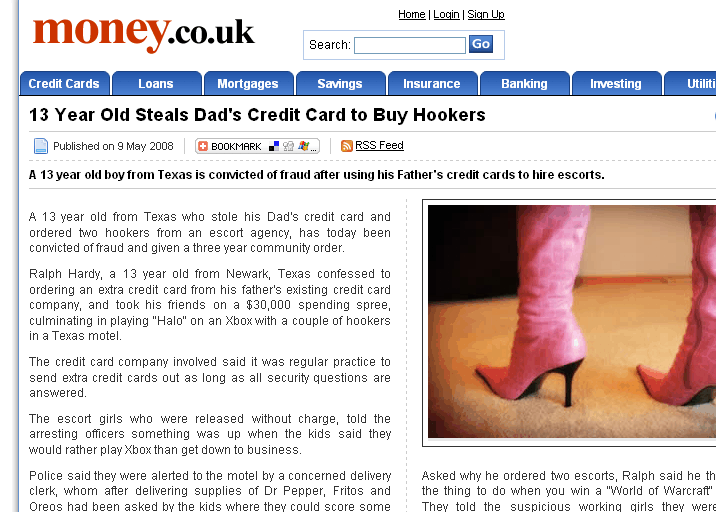
Over at Search Engine Land’s Sphinn, people are discussing a search engine optimization tactic which tries to assemble backlink juice by posting a fake news article. Jonathan Crossfield wraps it up: “Online marketer Lyndon Antcliff recently helped a client achieve over 1500 inbound links in under a week with a story designed to grab attention.” The article, titled “13 Year Old Steals Dad’s Credit Card to Buy Hookers,” was and still is hosted at the authoritative looking domain Money.co.uk, which is a financial advisor and Lyndon’s client, apparently. The hoax news explains that “Ralph Hardy, a 13 year old from Newark, Texas confessed to ordering an extra credit card from his father’s existing credit card company,” taking his friends on a $30,000 spending spree “culminating in playing ’Halo’ on an Xbox with a couple of hookers in a Texas motel.”
Jonathan continues to explain that the page received 2,452 votes at social news site Digg.com (it’s currently at 2,489 diggs, and not marked as incorrect, attracting comments like “Ballsy kid.”). Then, mainstream news made it into the mix. The hoax item was covered in Australia News.com.au, The Daily Telegraph, Fox News and many others, Jonathan says, and even reached the print version of UK’s Sun newspaper.
Google’s Matt Cutts makes a statement
Google’s anti webspam worker Matt Cutts at Sphinn gets involved too, making a statement in regards to the question “Where does [Cutts] and search engines stand on something like this?”. Matt argues, “My quick take is that Google’s webmaster guidelines allow for [as in “cover”] cases such as this,” citing the bit at the guidelines which reads “Google may respond negatively to other misleading practices not listed here (e.g. tricking users by registering misspellings of well-known websites). It’s not safe to assume that just because a specific deceptive technique isn’t included on this page, Google approves of it.” Matt Cutts says, “There’s not much more deceptive or misleading than a fake story without any disclosure that the story is hoax.”
I wonder if it should be any of Google’s business when a page games humans – and whether it should only be of their concern when a page games Google. Otherwise, Google risks becoming an editor for the web, additional to their existing strong traffic channeling power. In that role, they would have to decide what is correct reporting and what is not. In that role, Google would need to answer a lot of new questions, and they may not always be the most qualified to answer them.
For instance; should popular sites like The Onion, which claim to be “America’s Finest News Source,” be judged as deception or satire? What if search engine abusers simply disclaim their own hoax news as satire somewhere on the page? And what happens to news sources which some people would consider so badly researched or sensationalist that one may argue it borders on a hoax? What if the hoax has a bit of truth in it? Is hoaxing allowed on April 1st? Are April 1st articles allowed to reside on the server after the day, without disclosure? What about sites publishing fiction?
Once before, Matt Cutts argued that he thinks “of ’linkbait’ as something interesting enough to catch people’s attention, and that doesn’t have to be a bad thing. There are a lot of ways to do that, including putting in sweat-of-the-brow work to generate data or insights, or it can be as simple as being creative. You can also say something controversial to generate discussion”. (That last tactic, he argued, “gets tired if you overuse it, though”.)
As one example of a backlink-generating tactic that falls into the “generate controversy” camp, Matt Cutts lists Google-critical site Google-Watch.org. Incidentally, one of the theories of that site, Matt Cutts some years ago called “100% wrong”. That would make it similar to a hoax, it seems – and following Matt’s argument provided at Sphinn, that might make it a case which the webmaster guidelines may cover. As you can see, such editorializing would not only be tough and walking many gray areas... it could also start to become a conflict of interest for Google.
Keeping spam out of Google’s results
On the other hand, the fake article in question is also apparently search engine optimization spam – linking out to such heavily rank-battled topics like insurance, mortgage and loans, and perhaps using the word “credit card” in the title of the story just to increase keyword relevancy of backlinks towards this phrase. As a human editor, that convinced me to link out to the site using the “nofollow” attribute. So while it targeted human visitors to add manual backlinks, the real goal seems to have been gaming Google; as such, it may be in Google’s area to unspin the result ranking. Taken to the extreme, a Google search result filled with hoax articles becomes useless – unless someone is specifically looking for hoaxes.
Though – didn’t Google always state they rely on the democracy of the web to decide such things? The PageRank algorithm, which Google say is “the heart” of their software, relies on – according to Google – “the uniquely democratic nature of the web by using its vast link structure as an indicator of an individual page’s value.” If the democracy makes a bad decision – in this case, by having many of its web citizens misjudge the quality of a news item – is it Google’s job to jump in to overrule that decision?
Well, already, Google lets human editors decide which publishers make it into Google News, which in turn are displayed in some of Google’s main search results as News onebox. Also, Google already has human evaluators which indirectly affect rankings – as they can influence which ranking algorithms Google picks (even when Google argues the “beliefs and preferences of those who work at Google, as well as the opinions of the general public, do not determine or impact our search results”) –, and those human evaluators may give lower ratings to search result pages which put hoax stories in higher positions. And then there’s pages employing phishing or distributing a virus; in such cases, Google currently may display a warning in the search, but that flag perhaps does not affect the ranking and the page is still displayed.
Similar to the controversy around how Google expanded their fight against paid links via the push of the “nofollow” attribute (and lowering the PageRank of those who buy and sell links), if the “fake news” SEO tactic becomes more widespread, Google’s response to it may also trigger new discussions. Admittedly – if the nofollow discussions are any indicator, then while there may be lively debate around the topic, at this time it’s Google who makes the final decision. They may listen to webmasters and get involved, but in the end they won’t rely on just democracy or automation, but may come to an entirely human conclusion somewhere inside the Google headquarters.
Lyndon Antcliff removes his coverage of his hoax strategy
In the meantime, search engine optimizer Lyndon Antcliff, who started the hoax item, removed an article in which he gave insight into his tactics – tactics which, I would argue, are blackhat, and the exact kind of stuff that gives search engine optimization a bad name among so many outside the industry. Lyndon says, “After discussing it with a number of trusted colleagues I have taken the step of putting the ’Mental Linkbait’ behind closed doors. I had thought discussing tactics in an open way was a good thing but it seems I am giving too much away and was attracting a crowd I really don’t have any time for.” Lyndon adds, “I have little interest in discussing the ethics of linkbait, as far as I am concerned if it works and results are achieved then do it.”
One result seems to be clear in this, indeed, backlinks aside: Lyndon managed to lower the image of his apparent client, Money.co.uk, who got themselves involved in a very shady marketing technique (and this in turn may also give the “link democracy” another chance to get it right, by removing links to the site). “After all,” Jonathan Crossfield writes, “if this article is incorrect, how can a reader trust any of the financial advice contained on the site?”

comScore: Google Gets High Again In US Search Share
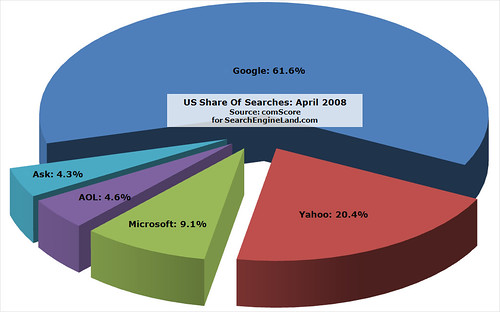
As with recent search stats from Hitwise and Nielsen, comScore's latest stats for April 2008 search engine share in the United States shows Google hitting a new high, breaking through the 60% mark for the first time with comScore's measurements.
Searches that happened on the five "core" search engines that comScore tracks stack up as follows:
- Google: 61.6%
- Yahoo: 20.4%
- Microsoft: 9.1%
- AOL: 4.6%
- Ask: 4.3%
The trend over time? Here's data going back to June 2007 (I don't have previous months because comScore changed its methodology, and I don't have adjusted figures prior to that period):

As you can see, Google set a new high for the period. Yahoo and Microsoft continued hitting new lows from their previous lows last month.
How about number of searches versus market share?
- Google: 6.5 billion
- Yahoo: 2.2 billion
- Microsoft: 961 million
- AOL: 491 million
- Ask: 458 million
The trend:
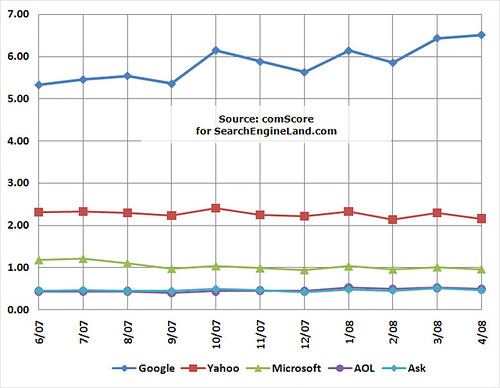
Sometimes a search engine like Yahoo or Microsoft can drop in share but still be stable in raw number of searches or even see an increase, due to the overall number of searches increasing. Not this month.
Caveat Time!
As a reminder, my general rules when evaluating popularity stats:
- Avoid drawing conclusions based on month-to-month comparisons. Lots of things can cause one month's figures to be incomparable to another month. It's better to see the trend across multiple months in a row.
- Avoid drawing conclusions based on one ratings service's figures. Each service has a unique methodology used to create popularity estimates. This means that ratings will rarely be the same between services. However, a trend that you see reflected across two or more services may give you faith in trusting that trend.
- Consider Actual Number Of Searches: While share for a particular search engine might drop, the raw number of searches might still be going up (and thus they might be earning more money, despite a share drop). This is because the "pie" of searches keeps growing, so even a smaller slice of the pie might be more than a bigger slice in the past.
Google Content Partner Site Examples re-launched
More partner site examples from the Google content network
Our advertisers have often asked: 'What kinds of web sites make up the Google content network?'To help answer this question, we just re-launched the Partners page on the Google content network microsite to include a more comprehensive set of examples of where your ads can appear. After all, the content network is comprised of hundreds of thousands of web sites, from information and news sites like About.com and the New York Times, to blogs like Ask the Builder. And while it's not possible to individually name all the sites in the content network, the revamped Partners page is meant to better demonstrate the variety of sites available. Below are some features of the new Partners page:
- Sites are organized by category. This will help you browse sites by categories that represent your target audience, such as Finance, News, Entertainment, Technology, etc. For example, if you sell herbal teas, you might browse through the Health & Fitness or Home & Garden categories to see examples of related sites. Or, if your target demographic is female, you can try the Women's Interest category.
- Once you find a site that's relevant to your product or service, you can use placement targeting to target your ads to that site directly. We recommend you use the Placement Tool to determine whether a specific site is available for targeting, and to identify other relevant placements to target. Further, if your campaign is already running on the content network, you can see the sites where your ad has appeared by running a Placement performance report.
- For those of you targeting users in other countries, a drop-down menu lets you browse partner sites in countries in Europe, Asia, and Latin America.
 (Click on the image for a full size version)
Abonnieren
Posts (Atom)