Donnerstag, 31. Juli 2008

Microsoft tries to one-up Google PageRank

Though a distant third place to Google, Microsoft thinks it can teach its rival a thing or two about searching the Internet.

A big part of Google's rise to search engine leadership was an algorithm called PageRank that assesses a specific page's importance by how many other Web pages link to it and by the importance of those linking pages. Microsoft researchers and academic collaborators, though, detailed an idea this week it calls BrowseRank that seeks to bring more of a human touch to that assessment.

Microsoft likes the results BrowseRank, which assigning Web page priority based on how people actually use the site.

Microsoft likes the results BrowseRank, which assigning Web page priority based on how people actually use the site.

(Credit: Microsoft ResearchA Asia)

Essentially, the researchers tested out a system that replaces PageRanks' link graph--a mathematical model of the hyperlinked connections of the Internet--with what they call a user browsing graph that ranks Web pages by people's behavior.

"The more visits of the page made by the users and the longer time periods spent by the users on the page, the more likely the page is important. We can leverage hundreds of millions of users' implicit voting on page importance," the researchers said in BrowseRank: Letting Web Users Vote for Page Importance, a paper from the SIGIR (Special Interest Group on Information Retrieval) conference this week in Singapore. Authors are Bin Gao, Tie-Yan Liu, and Hang Li from Microsoft Research Asia and Ying Zhang of Nankai University, Zhiming Ma of the Chinese Academy of Sciences, and Shuyuan He of Peking University.

Search is of tremendous importance to the Internet for many reasons. For one thing, search engines are highly influential middlemen that steer users to Web sites they may not be able to find on their own. For another, queries typed into search engines can be powerful--and in Google's case highly profitable--indications of what type of advertisement to place next to the search results.

But Microsoft lags leader Google and No. 2 Yahoo in search. It's trying hard to catch up, for example with unsuccessful proposals to acquire Yahoo or its search business that would cost the company billions of dollars. And Microsoft just bought search start-up Powerset.

Google isn't putting all its eggs in the PageRank basket, though.

"It's important to keep in mind that PageRank is just one of more than 200 signals we use to determine the ranking of a Web site," the company said in a statement. "Search remains at the core of everything Google does, and we are always working to improve it."

PageRank shortcomings
The Microsoft researchers argue that PageRank has a number of problems. For one thing, people can game the system by building bogus Web sites called link farms. Those sites feature hyperlinks point to a Web page whose importance a person wants to inflate so it appears higher in search results. Another PageRank issue is that the indexing process doesn't take into account the time a user spends on a particular site.

But user behavior, monitored in anonymous form by Web servers and Web browser plug-ins, can be better, the authors argue.

"Experimental results show that BrowseRank can achieve better performance than existing methods, including PageRank...in important page finding, spam page fighting, and relevance ranking.

The researchers gathered their data from "an extremely large group of users under legal agreements with them," according to the paper.

There's no denying PageRank is useful, though, and such algorithms could be added into a larger formula for determining which sites come out on top of search results.

"It is also possible to combine link graph and user behavior data to compute page importance," the researchers said. "We will not discuss more about this possibility in this paper, and simply leave it as future work."

Bringing research to fruition
It can be a long time before research comes to fruition, but funding a group of researchers can be much less expensive than acquiring other companies. No doubt Microsoft, especially after years of effort and its thwarted overtures to Yahoo, would like to see its in-house search efforts bring Google to its knees.

When accused of being dominant, Google representatives often argue the company could lose its search dominance if somebody else builds a better mousetrap and Internet users divert their path to that other door door. "If Microsoft or Yahoo are successful in providing similar or better web search results or more relevant advertisements, or in leveraging their platforms or products to make their Web search or advertising services easier to access, we could experience a significant decline in user traffic or the size of the Google (ad) Network," it said in its most recent quarterly report.

The top players are a moving target, though. Yahoo is hoping to improve search with three efforts: BOSS (build your own search service), which lets others employ Yahoo search results along with its search ads; SearchMonkey, which lets content publishers build elaborate mini-Web pages into search results; and Glue Pages, which present a smorgasbord of related content alongside search results.

And Google invests heavily, too. Its biggest research team is devoted to search, and the company updated its search formula more than 100 times in the second quarter. And researchers have huge infrastructure at their disposal to try new ideas.

"My group at Google has at its disposal many thousands of machines, with storage measured in petabytes," Udi Manber, head of Google's search quality, said of Google's search research infrastructure in a June talk. And, he added, engineers are empowered to try their results, with meetings once or twice a week to see how well they worked: "There is no separation of research and development. Everyone does both."

Google maps streetview: Kamera-Convoy

zeigst du mich, zeige ich dich...
2 google streetview camera cars hintereinander bei der tour de france nehmen sich gegenseitig auf

Live Search Adds Home Page "Hotspots"

Microsoft just announced the official U.S. launch of their new home page. The home page was seen in test mode a few months back, but now it is officially live.

The home page contains a background image, which contains "hotspots," used to show off some of the search queries available at Live Search. The home page background images are suppose to change over time and thus generate different query "hotspots," for the end users to play with.

Here is a picture of the new home page, as I see it now:

Live Search Home Page

If you look when the page loads, you will see hotspots fade in and out. If you hover your mouse over the page, you will notice that those hotspots will activate and show you a query. Here is one example of a hotspot on the Live Search home page:

Live Search Hotspot

This specific result took me to a Live Video Search query for animals in Bostwana. But other hotspots show off web search, map search and so on.

This looks like another way for Microsoft to generate more search queries, i.e. come play the Live Search home page scavenger hunt, if you will.

The Latest Cool SearchMonkey Apps

The Monkey has been out for a couple months and, since then, we've named the Developer Challenge winners and seen thousands of applications built -- more than 50 of which we've added to the Yahoo! Search Gallery. In the spirit of acknowledging developers' hard work, we want to share a few of our favorites. Remember, you need to click the "Add" button in the Search Gallery in order to see these in your Yahoo! Search results.

The enhancement
ShoppingNotes.com Combo

How it works
This Infobar was created by ShoppingNotes.com, a site that combines bookmarking with price alerts. The app covers a wide variety of shopping sites and allows users to set price watches that will send them an email if the price drops.

Add it
Add it, then try it out with: 'Canon SD1000' or 'KitchenAid mixer'


ShoppingNotes.com Combo


The enhancement
Java Documentation

How it works
This Enhanced Result is useful for developers because it gives you quick access to the Java docs for the version of Java you're using.

Add it
Add it, then try it out with: 'java HashMap'


Java Docs.


The enhancement
eHow Application

How it works
eHow, a site with clear how-to instructions for nearly everything, built an Enhanced Result that integrates photos and descriptions.

Add it
Add it, then try it out with: 'red wine stain' or 'how to train a dog'


eHow Application


The enhancement
Merriam-Webster Definition

How it works
Developer Challenge grand prize winner, Marco Vitanza, developed an Infobar for Merriam-Webster that gives users definitions and pronunciations right on the Search Results page.

Add it
Add it, then try it out with: 'onomastics definition'


Merriam-Webster Definition


These are just a few of the interesting apps already available in the Yahoo! Search Gallery. Stay tuned for more highlights to come...

Googles “userbezogene Suchergebnisse" transparenter und ist das der grund für den PR google dance?

As we continue to refine our search algorithms to deliver more relevant results, we strive to be as open as possible about how we use data to improve your search experience. Today, we're rolling out a new feature in Google Web Search that will help you better understand how your search results are already customized. Over the next few days, you may start to see messages like this in the upper right corner of your search results page (click on the image to view larger):

You can click the "More details" link to get to a page like this:

You'll see these new messages whenever your search results have been customized based on one or more of the following types of information:

  • Location. By default, we identify your approximate city location based on your computer's IP address and use it to customize your search results. If you'd like Google to use a different location, you can sign into or create a Google Account and provide a city or street address. Your specific location will be used not only for customizing search results, but also to improve your experience in Google Maps and other Google products.
  • Recent searches. We take into account whether a particular query followed on the heels of another query. Because recent search activity provides such valuable context for understanding the meaning behind your searches, we use it to customize your results whenever possible, regardless of whether you're signed in or signed out. In order to customize your results and show you the customization details, we keep the most recent query on your browser for a limited time. After that, the information is removed from your browser and disappears immediately if you close your browser.
  • Web History. If you're signed in and have Web History enabled, we customize your search results based on what you've searched for in the past on Google, and what web sites you've visited. One important note about Web History: it belongs to you and you have complete control over it. You can remove specific items or pause the service at any time. And if there's a particular search that you'd rather not have personalized based on your Web History, you can also just temporarily sign out of your Google Account.
This new feature doesn't change anything at all about how you search on Google and the results you get; it just gives you more of a behind-the-scenes look at how we customize your search experience. We consider this to be an important step in our commitment to transparency, and we hope you find it informative and useful.

Google Acquires Video Site Omnisio

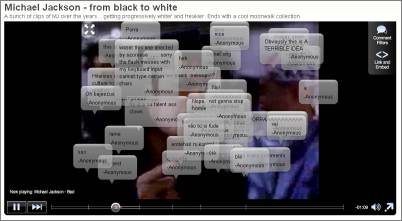
Google has bought video annotation site Omnisio to have their team join the YouTube team. Omnisio, allows users to mix together YouTube videos. Also, Omnisio visitors can add comments over the videos in specific time frames – a feature that made some early Omnisio videos completely unwatchable, but you’re now able to select whose comments you’d like to see overlaid.

The acquisition statement on the Omnisio homepage says, “We’ve been continually surprised by the creative and interesting stuff our users have built on the Omnisio platform – from hilarious video compilations, to witty (and yes sometimes over the top) in-video comments, to informative presentations with slides synced with video.” (Ionut Alex. Chitu’s comment: “I don’t know if YouTube’s community can write witty comments.”)

An online video editor is a good idea but it’s something the YouTube team didn’t manage to pull off so far, despite tries – their YouTube Remixer was slow and somewhat feature-weak when it was released, and it was later removed. Omnisio’s editor was a working start but I’m sure there’s still much more to improve in this space... perhaps that’s something the Omnisio founders Ryan Junee, Julian Frumar and Simon Ratner will be thinking about in the future.


Formerly hosted at youtube.com/ytremixer, the YouTube Remixer is now used or kidnapped as a normal channel (screenshot by Ars Technica)