Psion lässt Werbung für Netbooks über Google sperren
Psion pocht auf seine Markenrechte am Begriff "Netbook" und infolgedessen sperrt Google Werbung mit dem Begriff. So können Dritte über Google keine Werbung mehr schalten, in der dieser Begriff vorkommt.
Ende 2008 hatte Psion einige Websitebetreiber aufgefordert, das Wort Netbook nicht länger zu nutzen. Psion verweist darauf, dass die unerlaubte Nutzung der Marke nicht nur die Rechte von Psion verletzt, sondern diese Rechte auch gefährden kann. Das Unternehmen räumte den Angeschriebenen eine Übergangsfrist von drei Monaten ein und forderte dazu auf, bis Ende März 2009 auf einen neuen Begriff zu wechseln.
Psion hatte 1999 ein "netBook" auf Basis des Betriebssystems EPOC auf den Markt gebracht, verkauft heute aber nur noch Zubehör für die Geräte.
Im Zuge von Psions Bemühungen, seine Marke zu schützen, hat das Unternehmen seine Markenrechte auch gegenüber Google geltend gemacht. Wie üblich hat Google daraufhin die Buchung von Werbung mit den Begriffen über sein Werbesystem AdWords gesperrt. Dort heißt es nun: "Aus Gründen des Markenschutzes ist es AdWords-Kunden nicht gestattet, das Wort 'Netbook' in Google-AdWords-Anzeigen zu verwenden. Dieser Begriff ist entweder für eine bestimmte Produkt- oder eine Dienstleistungskategorie als Marke geschützt und darf nur in bestimmten Ländern verwendet werden." (ji)
Montag, 9. Februar 2009

Semantische Post für Dich
Forscher an der Stanford University wollen demnächst ein neuartiges E-Mail-System testen, das die Art, wie elektronische Botschaften ausgeliefert werden, radikal ändern könnte. "SEAmail" steht dabei für "semantische E-Mail-Adressierung" und erlaubt es, Nachrichten an Menschen zu senden, die bestimmte Kriterien erfüllen, ohne dass man deren genaue E-Mail-Anschriften oder gar Namen kennt.
E-Mail-Adressen seien ein "künstlicher Weg, Botschaften an die richtigen Leute zu senden", meint Michael Genesereth, Dozent für Computerwissenschaften in Stanford, der an SEAmail arbeitet. "Man möchte Nachrichten an Personen oder Funktionen schicken, nicht an eine Ansammlung von Buchstaben", sagt er. Semantische Technologien könnten dies künftig möglich machen. Die Idee dabei ist, Programme zu schaffen, die den Kontext einer Nachricht verstehen, so dass der Nutzer mit seiner Software natürlicher umgehen kann. Technische Details wie etwa die Notwendigkeit, eine Adresse anzugeben, werden in diesem System versteckt, Nutzer müssen sich darauf also nicht mehr konzentrieren.
Genesereth zufolge kam ein früherer Prototyp seiner Lösung, der unter Semantik-Forschern verwendet wurde, bereits hervorragend an. Beispielsweise konnten dabei Nutzer, die ihm eine Mail schicken wollten, einfach "Michael Genesereth" eingeben und seine jüngste Adresse wurde automatisch selektiert. Möglich waren auch Botschaften an Gruppen wie "alle Professoren, die seit 1960 Harvard abgeschlossen haben". SEAmail beherrscht beide Formen. Sein Adressbuch aktuell halten oder Zeit mit Namensrecherchen verbringen muss man dabei laut Genesereth nicht mehr.
Bei SEAmail selektiert ein Nutzer die Empfänger seiner Botschaft so, wie er eine Suchanfrage gestalten würde. Die Parameter können so einfach wie der Name einer Person sein oder so komplex wie eine Anzahl logischer Bedingungen. Doch das System ist zunächst darauf beschränkt, wie viel Material es über die möglichen Empfänger hat: "Um das volle Potenzial auszuschöpfen, brauchen wir einen reichen Datenbestand über die Personen, denen wir Mails schicken, über ihre Interessen und so weiter", sagt Genesereth. In einer Organisation gibt es normalerweise viele solcher Informationen. Die technische Herausforderung liegt nun darin, eine integrierte Version der Daten bereitzustellen, die SEAmail leicht nutzen kann. Die Informationen, aus denen sich die Professoren mit Harvard-Abschluss ermitteln lassen, würden beispielsweise aus mehreren Datenbanken stammen. Genesereth und sein Team suchen derzeit nach Wegen, bestehende Datenbanken zusammenzuführen, ohne dass sich an deren aktueller Struktur etwas ändert.
Im weiteren Internet dürfte es allerdings schwieriger sein, gute Daten für SEAmail zu finden – das räumt auch Genesereth ein. Obwohl es semantische Standards gibt, die dem System erlauben, Informationen aus Websites zu extrahieren, fürchtet er, dass veraltete Daten die Qualität beinträchtigen könnten.
"Diese Technologie hat klare Vorteile, sie kann aber auch missbraucht werden", meint Oren Etzioni, Direktor des Turing Center an der University of Washington. "Die technischen Probleme sind lösbar. Schwerer sind die sozialen: Wie kann man ein funktionierendes System schaffen, das die Launen der menschlichen Natur einbezieht?" Insbesondere fürchtet er, dass bestimmte Menschen mit dem Werkzeug womöglich sehr viele Mails erhalten würden, ohne Möglichkeit, diese wieder zu beschränken. Zwar könnten semantische Werkzeuge dabei zum Filtern verwendet werden, doch einen klaren Weg, den E-Mail-Fluss zu kontrollieren, ohne die Botschaften zu verlieren, die ein solches System nützlich machten, gebe es nicht.
Luke McDowell glaubt, dass semantische E-Mail-Adresslösungen in Verbindung mit anderen semantischen Technologien erst dann sinnvoll sind, sobald das Spamproblem gelöst ist. Der Computerforscher an der United States Naval Academy arbeitete selbst an einem System, das Informationen aus dem Körper von E-Mails extrahierte, um das Planen von Meetings zu vereinfachen. Mit Kontextinformationen sei es möglich, Aufgaben leichter zu automatisieren.
SEAmail soll noch in diesem Jahr innerhalb des Projektes einer "digitalen Abteilung" an der Stanford University getestet werden. Die Informatiker werden das System dabei als erste nutzen, bis dann die ganze Universität versorgt wird. Genesereth glaubt, dass die Technologie besonders bei großen Firmen ein hohes Potenzial habe. Hier sei das Missbrauchspotenzial auch am geringsten. "Mit etwas mehr Feinarbeit könnte es aber auch ein Werkzeug für das normale Internet werden."
Interesting Eye Tracking Studies By Google!
When we type a search query in Google, a number of search results are displayed in front us. Some of them are images, some of them are terms that are written in boldface and so on… Where do your eyes go first when you see that particular results page?
In a very interesting post on the Official Google Blog, Google has tried to provide us with an insight on their usability and eye-tracking studies — tests that help them know what their search results pages should look like.

The image above, is one of the examples to help us understand as to how users interact with a standard results page with 10 links. Here is what Google has to say on this image:
“Based on eye-tracking studies, we know that people tend to scan the search results in order. They start from the first result and continue down the list until they find a result they consider helpful and click it — or until they decide to refine their query. The heatmap below shows the activity of 34 usability study participants scanning a typical Google results page. The darker the pattern, the more time they spent looking at that part of the page. This pattern suggests that the order in which Google returned the results was successful; most users found what they were looking for among the first two results and they never needed to go further down the page.”
That means that a majority of people find what they are looking for in the first two results on the page only. And also, search result rankings play a very important role!
“We ran a series of eye-tracking studies where we compared how users scan the search results pages with and without thumbnail images. Our studies showed that the thumbnails did not strongly affect the order of scanning the results and seemed to make it easier for the participants to find the result they wanted.
The thumbnail image seemed to make results with thumbnails easy to notice when the users wanted them …

…and the thumbnails also seemed to make it easy for people to skip over the results with thumbnails when those results were not relevant to their search.”

http://www.youtube.com/v/w29DrEEsqT4
For the Universal Search team, this was a successful outcome. It showed that we had managed to design a subtle user interface that gives people helpful information without getting in the way of their primary task: finding relevant information.
In addition to search research, we also use eye-tracking to study the usability of other products, such as Google News and Image Search. For these products, eye-tracking helps us answer questions, such as "Is the 'Top Stories' link discoverable on the left of the Google News page?" or "How do the users typically scan the image results — in rows, in columns or in some other way?"
Eye-tracking gives us valuable information about our users' focus of attention — information that would be very hard to come by any other way and that we can use to improve the design of our products. However, in our ongoing quest to make our products more useful, usable, and enjoyable, we always complement our eye-tracking studies with other methods, such as interviews, field studies and live experiments.
Google AdSense Testing New Ad Format?
Speculations and guesswork are going on that Google AdSense is testing a new ad format. A lot of publishers are noticing this at DigitalPoint Forums
Here is the new format:

Some are saying that this format will bring in more revenue and others are saying that may be it is only the ads for the premium users.
Here are some of the responses:
“I am seeing such AdSense ad for the first time.
“I also see in one of my blogs last week…”
Forum discussion is going on at DigitalPoint Forums
Is The Worst Behind Us? Online Ad Revenues Pick Up In The Fourth Quarter.
Erick Schonfeld on February 5, 2009
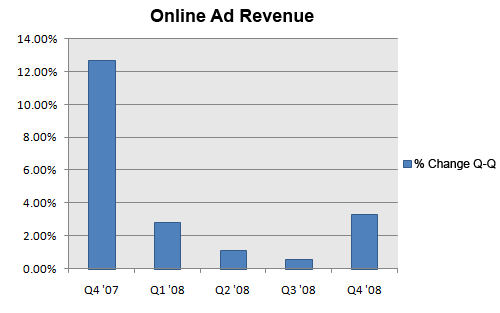
With Time Warner reporting earnings yesterday, we now have online advertising numbers for the fourth quarter from the four largest players: Google, Yahoo, Microsoft, and AOL. Tallying up their online advertising revenues provides a decent proxy for the health of the overall online advertising industry as a whole, since they represent a majority of those revenues. (For comparison, see IAB numbers for the U.S. only). After a full year of slowing growth, their combined ad revenues actually picked up in the fourth quarter, showing a 3 percent rise compared to the third quarter. Combined revenues grew 8 percent on an annual basis.
Like everyone else, I’ve been expecting to see continuing pressure on Internet advertising. In the third quarter, the sequential growth of the combined ad revenues from these four companies ground to a halt, going from 12.7 percent sequential growth in the fourth quarter of 2007 to 0.6 percent in the third. (All growth rates are quarter over quarter, unless otherwise noted).
What the slight rebound in growth tells us is that search advertising may be making up for the continued weakness in display advertising, which each of these companies acknowledged in their conference calls. The question is whether sequential growth will remain in this low range for the rest of the year, or whether search advertising can push it higher. One quarter’s worth of data is not enough to make any conclusons on that front, but at least these numbers provide a ray of hope.
The combined ad revenues totaled $8.5 billion in the fourth quarter, up from $8.2 billion in the third quarter and $7.8 billion in the fourth quarter of 2007. Google continued to dominate, accounting for 65 percent of those revenues, up from 61 percent from a year ago but slightly down from its 65.3 percent share in the third quarter. Google contributed slightly more than half of the growth. Yahoo’s 19.1 percent share of revenues went up quarter-over-quarter by the same amount that Google’s went down (0.3 percent). Microsoft’s $866 million in online revenues gave it a 10.2 share, up from 9.4 percent in the third quarter. And AOL’s advertising revenues remained flat at $507 million, giving it a 6.0 percent share (down 0.2 percent).
For the purposes of this analysis, I took the total advertising revenues from both Google and Yahoo, including their network revenues paid to affiliates, the online revenues reported by Microsoft, and only the advertising portion of AOL’s revenues. The revenue share figures above are rounded. Below are the absolute revenue numbers, broken down by company:
Update: We’ve updated the chart and table below to reflect more data going back to the third quarter of 2007. While there was an uptick in the quarterly growth rate in the fourth quarter, the 8 percent annual growth rate was still much slower than the 18 percent annual growth rate we saw in the third quarter. The big quarterly jumps began to temper in the fourth quarter of 2007, so that is only now beginning to be reflected in the year-over-year comparisons.


Abonnieren
Posts (Atom)