Freitag, 13. Februar 2009

Eine soziale Toolbar von Google

Mit der social bar erweitert und vereinfacht Google das eigene Friend Connect. Noch ist der Mehrwert überschaubar, aber die social bar hat echtes Potential.

Meine Lieblingsmetapher für Google ist die eines Nebels, der sich über das Web legt. Jede Webseite, die AdSense, Google Analytics, Google Maps oder einen beliebigen anderen Dienst von Google einbettet, macht diesen Nebel immer dichter und Google damit immer schlauer. Im Vergleich zu Google produzieren alle anderen Unternehmen bestenfalls Schäfchenwolken.

Aber einen der wichtigsten und erfolgreichsten Aspekte hat Google die längste Zeit verschlafen: Das soziale Web. Auch wenn sich Google seit kurzem die Phrase ‘The web is better when it’s social’ auf die eigene Fahne schreibt und diese Woche sogar ein Social Web Blog gestartet hat, wirkt fast alles, was Google im Umfeld des sozialen Webs unternimmt, wie ein unbeholfener Versuch, die Elemente erfolgreicher Sites zu kopieren. Sozial ist nicht in Googles DNA.

Die zwei wichtigsten Projekte von Google in diesem Bereich sind wohl OpenSocial und Google Friend Connect.

Zur Erinnerung: OpenSocial ist ein Kontainer, in dem soziale Widgets leben können, die auf eine schon bestehende Userbasis Zugriff bekommen. Friend Connect ist ein Bündel von sozialen Widgets, mit denen man beliebige Webseiten sehr einfach mit einigen sozialen Funktionen erweitern kann.

Mit der social bar hat Google jetzt Friend Connect ein interessantes Update verpasst.

Eines der Probleme mit Friend Connect war, dass die eingebetteten Widgets – Widgets gibt es für das User Management, für Kommentare, für Bewertungen und für vieles mehr – in das Layout der Site integriert werden mussten und deshalb auch wertvollen Raum konsumierten.

Die social bar vereint die wichtigsten Funktionen von Friend Connect in einer Navigationsleiste, die wahlweise am oberen oder unteren Ende der Webseite platziert werden kann. Besucher der eigenen Website sehen, wer auf der Site Mitglied ist und können sich als neue Mitglieder anmelden. Bereits registrierte Besucher können sich anmelden, kommentieren, die Seite bewerten oder sich miteinander befreunden. Alle Funktionen können von der social bar aus aktiviert werden, die jüngsten Aktivitäten werden dynamisch aktualisiert.

Die Einbindung in die eigene Site ist ein Kinderspiel und in 5 Minuten erledigt. Das Layout muss nicht verändert werden. Wen die Anwesenheit einer Navigationsleiste also nicht stört, der kann sofort loslegen.

Für neue Mitglieder ist die Anmeldung einfach. Sie können sich mit einem bestehenden Google-Account oder via OpenID registrieren. Es dürfte wohl auch nicht lange dauern, bis die social bar auch einen Wiedererkennungswert hat. Viele Besucher werden also bald ohne Erklärungen wissen, was sie damit machen können und welche Vorteile sie von einer Mitgliedschaft hätten.

socialbar
socialbar

Der Wow-Effekt bleibt allerdings aus. Derzeit sind die angebotenen Funktionen noch zu limitiert. Aber die social bar hat Potential, weil sie offen für Verbesserungen ist.

Gmail-User wissen, wie kreativ Google sein kann, wenn es den Fokus auf einen Dienst legt. Es vergeht keine Woche, an der nicht zwei oder drei neue Funktionen für Gmail vorgestellt werden, die Benutzer individuell aktivieren können. Die meisten neuen Features sind übrigens Ergebnisse der 20%-Regelung, bei der Mitarbeiter einen Arbeitstag pro Woche für eigene Projekte verwenden können.

Ein guter UI-Designer könnte die social bar um einiges verbessern. Und wenn Google die social bar für andockbare Module öffnet, könnten wir bald eine Fülle an attraktiven Funktionen sehen, die den Wert einer Website tatsächlich erhöhen. Je grösser die Anreize werden, desto mehr Sites werden auch davon Gebrauch machen. Was uns wieder zurück zum Nebel bringt.

YouTube mit kostenpflichtigen Downloads

YouTube

Dass Google mit YouTube nicht unbedingt viel Geld verdient, ist bekannt. Jetzt gibt es erste Hinweise, dass man Videos völlig legal herunterladen kann. Bereits seit einigen Wochen kann man Videos von ChangeDotGov herunterladen. In diesem Channel kann man sich Videos rund um den Amtswechsel in den USA anschauen.

Eine Hilfeseite erklärt nun, dass man Videos von YouTube Partner gegen Entgelt herunterladen kann. Die Bezahlung erfolgt über Google Checkout, was wiederum heißt, dass man eine Kreditkarte benötigt. Das Video wird als mp4 gespeichert. Ein Partner Video, dass den Download offiziell anbietet, konnte ich nicht finden. Aber immer mehr Videos, die unter einer freien Lizenz wie Creative Commons stehen, können heruntergeladen werden.

Händler messen Erfolg von Onlinemarketing nicht

Können Sie Besucher oder Umsätze einer Kampagne zuordnen?
(Grafik: ibi research)

Onlinemarketing ist für Internethändler selbstverständlich. Suchmaschinenoptimierung und -werbung sowie der Versand von Newslettern sind die am häufigsten eingesetzten Marketinginstrumente. Jedoch untersucht nur die Hälfte der Unternehmen, ob sich diese Maßnahmen wirklich lohnen.

Die aktuelle Studie E-Commerce in Deutschland von ibi research an der Universität Regensburg zeigt, dass drei Viertel der Händler auf Suchmaschinenoptimierung setzen, um Besucher in ihren Webshop zu locken. Über die Hälfte schaltet auch Suchmaschinenwerbung und informiert per Newsletter über die angebotenen Produkte.

Diese Maßnahmen verursachen zum Teil erhebliche Kosten. Jeder vierte Händler gibt für Marketing-Aktivitäten mehr als 10.000 Euro pro Jahr aus, bei zwei von fünf sind es mehr als 5.000 Euro. Suchmaschinenwerbung und Zeitungsanzeigen sind dabei die größten Kostenblöcke. Der Erfolg dieser Investitionen bleibt vielen Onlinehändlern aber verborgen. Nur gut 40 Prozente der befragten Unternehmen wissen, wie viele Besucher eine Kampagne generiert hat. Und nur 36 Prozente der Firmen, die einen Newsletter versenden, kennen dessen Öffnungsrate.


Händler wollen Webcontrolling ausbauen

„Es überrascht, dass so wenige Händler sich mit der Wirkung ihrer Marketing-Maßnahmen auseinandersetzen", kommentiert Ernst Stahl von ibi research die Untersuchungsergebnisse. „Insbesondere, da Onlinehändler mithilfe von Web-Controlling-Tools sehr leicht feststellen können, wie gut beispielsweise die Marketing-Aktionen bei ihren Kunden ankommen". Ein Viertel der befragten Onlinehändler setzt gegenwärtig überhaupt kein Web-Controlling-Tool ein.

Viele Unternehmen planen jedoch, ihre Web-Controlling-Aktivitäten auszubauen. So wollen knapp 40 Prozent das Nutzerverhalten zukünftig regelmäßig analysieren, um Verbesserungsmöglichkeiten zu identifizieren. Annähernd jeder zweite Händler will zudem Kundenbefragungen zur Identifizierung von Verbesserungsmöglichkeiten einsetzen.

Für die Untersuchung „E-Commerce in Deutschland" wurden rund 700 Onlinehändler befragt. ibi research bietet die Studie kostenlos zum Download an.


Donnerstag, 12. Februar 2009

Big pharma eyeing digital marketing push in 2009

The pharmaceutical industry is preparing to make a big push in the digital marketing space in 2009, according to a new survey from MarketBridge. Although the industry is largely behind the curve when it comes to digital marketing, nearly 45 percent of pharmaceutical executives made it clear that they need to better understand the opportunity, and more than a third said they're not adequately organized to take advantage, ClickZ reports.

Half of all those who responded to the "Digital Marketing in Pharma" survey said less than 10 percent of their company's marketing budget is allocated to digital. Moreover, there's still a great deal of uncertainty among pharmaceutical companies about whether they can prove a substantial return on investment if they put more efforts into digital marketing.

At least 72 percent of all respondents said they would be investing more in 2009, although that may be tempered somewhat by the recession. Partha Krishnamurthy, director of the University of Houston's Institute for Health Care Marketing, suggests that large pharmaceutical companies face significant risk if they embrace Web 2.0. By its very nature, digital marketing will give consumers a louder voice in shaping a brand's message, and those with the most negative experiences can easily rise to the top.

Agency discovers benefits of using Twitter as a focus group

In a short article, The Archer Group CEO and founder Lee Mikles said his interactive shop was able to generate buzz on Twitter following a series of banner campaigns. The campaign aimed to generate interest in a group of products being launched by the shop's client, and the tweets began popping up online almost immediately after the banners went live.

Oddly enough, the majority of Twitter messages were raving about a new product that wasn't being promoted in the campaign. After regrouping with the client, however, The Archer Group began advertising the new product as well, and it became more successful than all the others. The clickthrough rate on the new product was 55 percent higher than the rest of the campaign, Mikles wrote.

While the number of tweets referencing the new product was small, the amount of people who followed the new banners was on a much greater scale. Mikles concluded by saying that Twitter continues to be a "great tool for us to monitor buzz about products or campaigns for our clients… It's an example of how, more broadly, social networking has taken conversations that previously happened around water coolers and put them online, making them searchable by marketers."

Badvertising: Citibank Inserts Advertising Into Your Account Activity

Reader Eric was looking at his credit card account activity when he noticed something odd. No, it wasn't an unauthorized charge. It was advertising.

I just thought I'd let you know that I noticed that Citi is now putting ads on my "Recent Activity" section on citicards.com. I am really shocked that they would do this. I know many banks put ads/offers on statements but I am shocked that they would put it in there as to make it look like it's my account activity.

We Googled your issue and found a guy who was irritated enough to figure out how to get Firefox to remove the ads.

Affiliate und SEM: So werden saisonale Such-Trends optimal genutzt

aus ibusiness:

Feiertage, Urlaubsbeginn oder die Weihnachtszeit sind bei Marketern besonders beliebt. Denn zu diesen saisonalen Anlässen sind Kampagnen in der Regel besonders erfolgreich. Das Affiliatenetzwerk Zanox hat in einem Live-Test am Beispiel Valentinstag herausgearbeitet, wie Werbungtreibende zu diesen Anlässen werben sollten, um das Maximum an Erfolg aus ihren Kampagnen herauszuholen.
Wann ein Affiliate seine Keywords zum Valentistag optimal schalten sollte, hat Zanox in einem Live-Test untersucht

'Valentinstag' oder 'Blumenversand' - nach solchen Keywords wird insbesondere rund um den Valentinstag und Muttertag besonders häufig gesucht. Wie solche Such-Trends für das professionelle Suchmaschinenmarketing von Affiliates erfolgreich genutzt werden können, hat das Affiliatenetzwerk Zanox zur Homepage dieses Unternehmnes Relation Browser im Live-Test mit der Landingpage Blumenkuriere.de Relation Browser herausgefunden.

Dazu hat Denis Maibaum Denis Maibaum auf Xing nachschlagen, Global Product Manager bei Zanox, mit Blumenkuriere.de Relation Browser ein eigenes exemplarisches Affiliate-Projekt erstellt und mit dem der hauseigenen Tracking-Lösung 'Look@Landingpages' gemessen. Die Microsite bildet Affiliate-Programme von Blumenversendern ab und vergleicht deren Service. "Im letzten Jahr war der Peak zwar kurz, dafür aber umso steiler und profitabler: Es gab eine Verzehnfachung der Suchanfragen und eine Erhöhung der Conversion Rate um mindestens 50 Prozent", fasst Maibaum die Ergebnisse des Tests zusammen.

Einen Tag vor Ultimo ist der beste Zeitpunkt sein Keyword zu schalten

links,,,Einen Tag vor Ultimo ist der beste Zeitpunkt sein Keyword zu schalten
(Bild: ZANOX.de AG)
Aus diesen Erfahrungen des vergangenen Jahres lassen sich laut Maibaum Strategien für den kommenden Valentinstag am 14. Februar 2009 für Affiliates und Agenturen ableiten:

1. Heraufsetzen der Cost-per-Click-Gebote in der Woche vor dem Valentinstag, aber nur maximal bis 11 Uhr am Valentinstag selbst - danach ist das Suchvolumen zwar noch noch, aber die Verkäufe nehmen extrem ab, die Conversion Rates brechen zusammen.
2. Bei einigen Versendern werden bereits ab dem 13. Februar, 15 Uhr, keine Aufträge mehr angenommen - dies sollte bei den CPC-Geboten beachtet werden.
3. Sobald der Zeitpunkt erreicht ist, sollten die CPC-Gebote deutlich unter Normalniveau abgesenkt werden, damit nicht unnötig Geld verbrannt wird.


Mit dieser Strategie konnte Maibaum im Februar vergangenen Jahres 1.546 Sales mit einem Gesamtumsatz von 5.675 Euro mit nur einer einzigen HTML-Seite erzielen. "Wichtig ist, die richtige Nische zu finden und dann konsequent am Ball zu bleiben", sagt Maibaum. Für Affiliates sollte das Keyword-Tracking für ihre Partnerprogramme mittlerweile ein Standardprozess sein, fordert Maibaum.

Das Verhältnis von Umsatz und Kosten beim Blumenkuriert-Test

Das Verhältnis von Umsatz und Kosten beim Blumenkuriert-Test
(Bild: ZANOX.de AG)
Die Vorteile des ausgewählten Bereichs Blumenversand: Geringe Stornoquoten, da es um ein stark emotionales Produkt geht, noch dazu mit wenig Retouren und guter Zahlungsmoral. Diese Vorteile kennt auch Lars Enneper Lars Enneper auf Xing nachschlagen, Online Marketing Manager bei Fleurop Relation Browser, dem Marktführer der Online-Blumenversanddienste. "Der 'verliebte Mann‘ ist als Zielgruppe für uns hochinteressant, weil der so genannte Warenkorbwert (WKW) besonders hoch liegt", weiß Enneper zu berichten. "Neben dem Aufbau von Landingpages und dem gezielten Suchmaschinenmarketing, nutzen wir auch andere, männeraffine Umfelder, um noch mehr Traffic auf die Seiten zu bekommen: Beispielsweise Sport- und Auto-Seiten." Die Zielgruppe zeichne sich auch dadurch aus, dass sie eher kurzfristig agiere: Kein Wunder also, dass im vergangenen Jahr die meisten Verkäufe über blumenkuriere.de nur zwei Tage vor Valentinstag generiert wurden - die Spitze lag bei 313 Verkäufen an jenem 13. Februar 2008. "Wer diese Tipps beherzigt", so Denis Maibaum abschließend, "kann auch noch dieses Jahr saftige Gewinne erwirtschaften."

Welche Keywords zu welchen saisonalen Anlässen besonders häufig von den Nutzern im Internet gesucht werden, wertet Affiliate-Experte Karsten Windfelder in seinem Dienst Affiliate-Kalender.de

Montag, 9. Februar 2009

Google sperrt "Netbooks"

Psion lässt Werbung für Netbooks über Google sperren

Psion pocht auf seine Markenrechte am Begriff "Netbook" und infolgedessen sperrt Google Werbung mit dem Begriff. So können Dritte über Google keine Werbung mehr schalten, in der dieser Begriff vorkommt.

Ende 2008 hatte Psion einige Websitebetreiber aufgefordert, das Wort Netbook nicht länger zu nutzen. Psion verweist darauf, dass die unerlaubte Nutzung der Marke nicht nur die Rechte von Psion verletzt, sondern diese Rechte auch gefährden kann. Das Unternehmen räumte den Angeschriebenen eine Übergangsfrist von drei Monaten ein und forderte dazu auf, bis Ende März 2009 auf einen neuen Begriff zu wechseln.

Psion hatte 1999 ein "netBook" auf Basis des Betriebssystems EPOC auf den Markt gebracht, verkauft heute aber nur noch Zubehör für die Geräte.

Im Zuge von Psions Bemühungen, seine Marke zu schützen, hat das Unternehmen seine Markenrechte auch gegenüber Google geltend gemacht. Wie üblich hat Google daraufhin die Buchung von Werbung mit den Begriffen über sein Werbesystem AdWords gesperrt. Dort heißt es nun: "Aus Gründen des Markenschutzes ist es AdWords-Kunden nicht gestattet, das Wort 'Netbook' in Google-AdWords-Anzeigen zu verwenden. Dieser Begriff ist entweder für eine bestimmte Produkt- oder eine Dienstleistungskategorie als Marke geschützt und darf nur in bestimmten Ländern verwendet werden." (ji)

Semantische Post für Dich

Forscher an der Stanford University wollen demnächst ein neuartiges E-Mail-System testen, das die Art, wie elektronische Botschaften ausgeliefert werden, radikal ändern könnte. "SEAmail" steht dabei für "semantische E-Mail-Adressierung" und erlaubt es, Nachrichten an Menschen zu senden, die bestimmte Kriterien erfüllen, ohne dass man deren genaue E-Mail-Anschriften oder gar Namen kennt.

E-Mail-Adressen seien ein "künstlicher Weg, Botschaften an die richtigen Leute zu senden", meint Michael Genesereth, Dozent für Computerwissenschaften in Stanford, der an SEAmail arbeitet. "Man möchte Nachrichten an Personen oder Funktionen schicken, nicht an eine Ansammlung von Buchstaben", sagt er. Semantische Technologien könnten dies künftig möglich machen. Die Idee dabei ist, Programme zu schaffen, die den Kontext einer Nachricht verstehen, so dass der Nutzer mit seiner Software natürlicher umgehen kann. Technische Details wie etwa die Notwendigkeit, eine Adresse anzugeben, werden in diesem System versteckt, Nutzer müssen sich darauf also nicht mehr konzentrieren.

Genesereth zufolge kam ein früherer Prototyp seiner Lösung, der unter Semantik-Forschern verwendet wurde, bereits hervorragend an. Beispielsweise konnten dabei Nutzer, die ihm eine Mail schicken wollten, einfach "Michael Genesereth" eingeben und seine jüngste Adresse wurde automatisch selektiert. Möglich waren auch Botschaften an Gruppen wie "alle Professoren, die seit 1960 Harvard abgeschlossen haben". SEAmail beherrscht beide Formen. Sein Adressbuch aktuell halten oder Zeit mit Namensrecherchen verbringen muss man dabei laut Genesereth nicht mehr.

Bei SEAmail selektiert ein Nutzer die Empfänger seiner Botschaft so, wie er eine Suchanfrage gestalten würde. Die Parameter können so einfach wie der Name einer Person sein oder so komplex wie eine Anzahl logischer Bedingungen. Doch das System ist zunächst darauf beschränkt, wie viel Material es über die möglichen Empfänger hat: "Um das volle Potenzial auszuschöpfen, brauchen wir einen reichen Datenbestand über die Personen, denen wir Mails schicken, über ihre Interessen und so weiter", sagt Genesereth. In einer Organisation gibt es normalerweise viele solcher Informationen. Die technische Herausforderung liegt nun darin, eine integrierte Version der Daten bereitzustellen, die SEAmail leicht nutzen kann. Die Informationen, aus denen sich die Professoren mit Harvard-Abschluss ermitteln lassen, würden beispielsweise aus mehreren Datenbanken stammen. Genesereth und sein Team suchen derzeit nach Wegen, bestehende Datenbanken zusammenzuführen, ohne dass sich an deren aktueller Struktur etwas ändert.

Im weiteren Internet dürfte es allerdings schwieriger sein, gute Daten für SEAmail zu finden – das räumt auch Genesereth ein. Obwohl es semantische Standards gibt, die dem System erlauben, Informationen aus Websites zu extrahieren, fürchtet er, dass veraltete Daten die Qualität beinträchtigen könnten.

"Diese Technologie hat klare Vorteile, sie kann aber auch missbraucht werden", meint Oren Etzioni, Direktor des Turing Center an der University of Washington. "Die technischen Probleme sind lösbar. Schwerer sind die sozialen: Wie kann man ein funktionierendes System schaffen, das die Launen der menschlichen Natur einbezieht?" Insbesondere fürchtet er, dass bestimmte Menschen mit dem Werkzeug womöglich sehr viele Mails erhalten würden, ohne Möglichkeit, diese wieder zu beschränken. Zwar könnten semantische Werkzeuge dabei zum Filtern verwendet werden, doch einen klaren Weg, den E-Mail-Fluss zu kontrollieren, ohne die Botschaften zu verlieren, die ein solches System nützlich machten, gebe es nicht.

Luke McDowell glaubt, dass semantische E-Mail-Adresslösungen in Verbindung mit anderen semantischen Technologien erst dann sinnvoll sind, sobald das Spamproblem gelöst ist. Der Computerforscher an der United States Naval Academy arbeitete selbst an einem System, das Informationen aus dem Körper von E-Mails extrahierte, um das Planen von Meetings zu vereinfachen. Mit Kontextinformationen sei es möglich, Aufgaben leichter zu automatisieren.

SEAmail soll noch in diesem Jahr innerhalb des Projektes einer "digitalen Abteilung" an der Stanford University getestet werden. Die Informatiker werden das System dabei als erste nutzen, bis dann die ganze Universität versorgt wird. Genesereth glaubt, dass die Technologie besonders bei großen Firmen ein hohes Potenzial habe. Hier sei das Missbrauchspotenzial auch am geringsten. "Mit etwas mehr Feinarbeit könnte es aber auch ein Werkzeug für das normale Internet werden."

Interesting Eye Tracking Studies By Google!

When we type a search query in Google, a number of search results are displayed in front us. Some of them are images, some of them are terms that are written in boldface and so on… Where do your eyes go first when you see that particular results page?

In a very interesting post on the Official Google Blog, Google has tried to provide us with an insight on their usability and eye-tracking studies — tests that help them know what their search results pages should look like.

Eye Tracking Studies By Google

The image above, is one of the examples to help us understand as to how users interact with a standard results page with 10 links. Here is what Google has to say on this image:

“Based on eye-tracking studies, we know that people tend to scan the search results in order. They start from the first result and continue down the list until they find a result they consider helpful and click it — or until they decide to refine their query. The heatmap below shows the activity of 34 usability study participants scanning a typical Google results page. The darker the pattern, the more time they spent looking at that part of the page. This pattern suggests that the order in which Google returned the results was successful; most users found what they were looking for among the first two results and they never needed to go further down the page.”

That means that a majority of people find what they are looking for in the first two results on the page only. And also, search result rankings play a very important role!

“We ran a series of eye-tracking studies where we compared how users scan the search results pages with and without thumbnail images. Our studies showed that the thumbnails did not strongly affect the order of scanning the results and seemed to make it easier for the participants to find the result they wanted.

The thumbnail image seemed to make results with thumbnails easy to notice when the users wanted them …

Eye Tracking Studies By Google

…and the thumbnails also seemed to make it easy for people to skip over the results with thumbnails when those results were not relevant to their search.”

Eye Tracking Studies By Google


http://www.youtube.com/v/w29DrEEsqT4

For the Universal Search team, this was a successful outcome. It showed that we had managed to design a subtle user interface that gives people helpful information without getting in the way of their primary task: finding relevant information.

In addition to search research, we also use eye-tracking to study the usability of other products, such as Google News and Image Search. For these products, eye-tracking helps us answer questions, such as "Is the 'Top Stories' link discoverable on the left of the Google News page?" or "How do the users typically scan the image results — in rows, in columns or in some other way?"

Eye-tracking gives us valuable information about our users' focus of attention — information that would be very hard to come by any other way and that we can use to improve the design of our products. However, in our ongoing quest to make our products more useful, usable, and enjoyable, we always complement our eye-tracking studies with other methods, such as interviews, field studies and live experiments.

Google AdSense Testing New Ad Format?

Speculations and guesswork are going on that Google AdSense is testing a new ad format. A lot of publishers are noticing this at DigitalPoint Forums

Here is the new format:

Google AdSense New Ad Format

Some are saying that this format will bring in more revenue and others are saying that may be it is only the ads for the premium users.

Here are some of the responses:

“I am seeing such AdSense ad for the first time.
“I also see in one of my blogs last week…”

Forum discussion is going on at DigitalPoint Forums

Is The Worst Behind Us? Online Ad Revenues Pick Up In The Fourth Quarter.

Erick Schonfeld on February 5, 2009

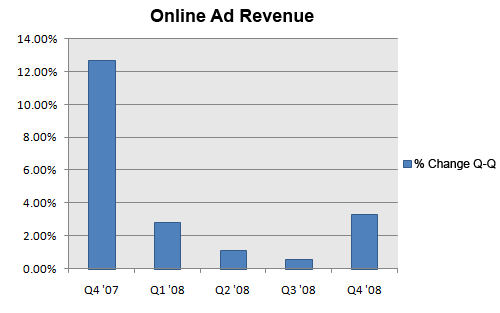
With Time Warner reporting earnings yesterday, we now have online advertising numbers for the fourth quarter from the four largest players: Google, Yahoo, Microsoft, and AOL. Tallying up their online advertising revenues provides a decent proxy for the health of the overall online advertising industry as a whole, since they represent a majority of those revenues. (For comparison, see IAB numbers for the U.S. only). After a full year of slowing growth, their combined ad revenues actually picked up in the fourth quarter, showing a 3 percent rise compared to the third quarter. Combined revenues grew 8 percent on an annual basis.

Like everyone else, I’ve been expecting to see continuing pressure on Internet advertising. In the third quarter, the sequential growth of the combined ad revenues from these four companies ground to a halt, going from 12.7 percent sequential growth in the fourth quarter of 2007 to 0.6 percent in the third. (All growth rates are quarter over quarter, unless otherwise noted).

What the slight rebound in growth tells us is that search advertising may be making up for the continued weakness in display advertising, which each of these companies acknowledged in their conference calls. The question is whether sequential growth will remain in this low range for the rest of the year, or whether search advertising can push it higher. One quarter’s worth of data is not enough to make any conclusons on that front, but at least these numbers provide a ray of hope.

The combined ad revenues totaled $8.5 billion in the fourth quarter, up from $8.2 billion in the third quarter and $7.8 billion in the fourth quarter of 2007. Google continued to dominate, accounting for 65 percent of those revenues, up from 61 percent from a year ago but slightly down from its 65.3 percent share in the third quarter. Google contributed slightly more than half of the growth. Yahoo’s 19.1 percent share of revenues went up quarter-over-quarter by the same amount that Google’s went down (0.3 percent). Microsoft’s $866 million in online revenues gave it a 10.2 share, up from 9.4 percent in the third quarter. And AOL’s advertising revenues remained flat at $507 million, giving it a 6.0 percent share (down 0.2 percent).

For the purposes of this analysis, I took the total advertising revenues from both Google and Yahoo, including their network revenues paid to affiliates, the online revenues reported by Microsoft, and only the advertising portion of AOL’s revenues. The revenue share figures above are rounded. Below are the absolute revenue numbers, broken down by company:

Update: We’ve updated the chart and table below to reflect more data going back to the third quarter of 2007. While there was an uptick in the quarterly growth rate in the fourth quarter, the 8 percent annual growth rate was still much slower than the 18 percent annual growth rate we saw in the third quarter. The big quarterly jumps began to temper in the fourth quarter of 2007, so that is only now beginning to be reflected in the year-over-year comparisons.

Dienstag, 3. Februar 2009

Load Time of Google Analytics Script

If you depend on Google Analytics to track your site’s traffic, then your page’s load time are to some extent affected by the load time of Google Analytics (putting the GA script towards the end of the page helps, but a load bar may still show longer). Pingdom in an email writes, in reference to their full report:

We have monitored the load time performance (download speed) of the Google Analytics scripts (both ga.js and urchin.js) from Google’s servers, and have found a very interesting performance pattern, especially in Europe.

The Google Analytics scripts load 27% slower at peak hours in North America, and 97% slower at peak hours in Europe (i.e. from European locations).

Google Web Search Goes Completely AJAX

by smackdown:

Yes, I know… Google has been offering AJAX driven results through the API and other services for ages, but now they have rolled that out to the main Google Search. It appears to be only on Google US (I tried manually switching to Google UK, and it redirected me from the AjAX version to a static HTML page), but that of course could change in the future.

I noticed this as soon as I started searching for stuff today, from almost the first query I typed in. When I looked at the url, instead of seeing the normal /search?= at the beginning:

Normal Google search url

I found myself looking at this:

Google AJAX search url

You can see that the query string, the portion of the url that sends parameters such as what keywords you are looking for and how many results per page you want to see to the server, has been removed, and that Google has replaced it with a hash tag, the part or the url that is normally only read by the browser itself (everything after the pound or number sign, shift-3 on the keyboard: “#”). This was what first clued me in to the fact that they had changed over, as this is a common visual way to indicate a “page change” to the user, letting them know that they have gone from one page to another in AJAX (which can perform the changes with no url change at all), and allows the Back and Forward buttons to still trigger AJAX calls.

I verified that this is indeed what is happening by performing a search, viewing the source of that search, and then looking inside that source for some text that I knew was on the page. For example, if you perform a search for [bad neighborhood]:

Google AJAX search for [bad neighborhood]

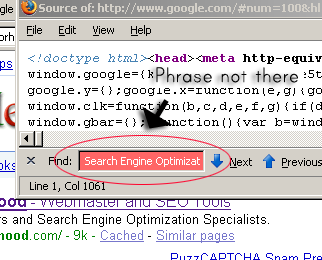
and then view the source, and search for [Search Engine Optimization] (which is clearly on the page):

Google AJAX search for [bad neighborhood] highlighted phrase

you can see that it’s nowhere to be found:

Google AJAX source, on page text is not there

So, what does that mean for us as searchers? To be honest I’m not sure of the full impact of this yet. I do know that AJAX can use more memory than pages generated by flat HTML, especially in Internet Explorer, so some older machines with fewer resources (such as those that might be prevalent in struggling businesses during economy strapped times) will possibly have performance issues. Also, certain Greasemonkey scripts will break with this change, like the handy Number Google Results, the script that allows you to insert sequential numbering into Google results, so you know where a site ranks at a glance without having to count.

As Google does with so many of it’s roll outs, there is no way to turn this feature off, either… so if it does affect you, tough. Google apparently doesn’t care. For now you can manually change the url by hand, but that is of course a pain in the keister. If anyone else finds other issues with this new change, or ways that it impacts us as searchers (or as seo’s, for that matter), please chime in.

Montag, 2. Februar 2009

Google Adwords Updated Interface Beta

Today while logged into My Client Center in Google Adwords, I received an invite to Beta Test the Updated Adwords Interface.

Google Adwords Updated Interface Beta

Google Adwords Updated Interface Beta

I am glad they asked.

Over time, I have noticed many functionality issues throughout my Google Adwords dashboard.

I would have reported my findings some place other than here on this blog had I known who to contact or where to report my discoveries.

For example, one Adwords usability issue I discovered was the inability of My Client Center account users to dismiss Alerts from their Alert center after they were read.

Adwords has finally added a check box to dismiss some My Client Center Alerts but not all of them.

From the Adwords Updated Interface Beta:

Updated Interface Beta

Updated Interface Beta

I am looking forward to participating in the Google Adwords Updated Interface Beta.

I am switching to the Updated Interface now and will share any suggestions I have for increasing Google Adwords account management usability both here on this blog and directly with the Adwords Updated Interface Beta team.

How To Switch

How To Switch

First Screen Shot of the Google Adwords Updated Interface Beta:

New Adwords Interface


(in DE habe ich noch keine freischaltung für den adwords 3.0 beta test bekommen...)

Google hat seine Datenschutzerklärung geändert

Bereits am 27. Januar hat Google die Datenschutzerklärung geändert. Die Änderungen erlauben Google nun zu protokollieren wie oft und wie lange ein Nutzer einen Google Service nutzt. Google will durch diese Daten Phishing verhindern.

"Um Sie darüber hinaus vor Betrug, Phishing und anderem Fehlverhalten zu schützen, werden unter Umständen Ihre Interaktionen mit unseren Services erfasst. Derartige von uns erfassten Informationen dienen ausschließlich der Erkennung und Verhinderung von Betrugsversuchen oder anderem Fehlverhalten," heißt es jetzt in den Datenschutzbestimmungen.

Die Änderungen wurden am sogenannten Data Privacy Day eingeführt.

» Google Public Policy

Google AdWords Requiring One Domain Per Ad Group?

"In an effort to provide more relevant results and a higher quality experience for our users, we have made the decision to no longer allow multiple domains within a single ad group. Going forward, all display URLs within an ad group must be for the same top-level domain. Please note that this amendment to our policy applies to all advertisers, regardless of previous exceptions or acceptability of any campaigns. While we understand there are legitimate use-cases for multiple domains within one ad group, we ask that separate ad groups are created for any given domain.

For instructions on editing your display URL, please see https://adwords.google.com/support/bin/answer.py?answer=6272&hl=en_US

Please know that we will not be retroactively disapproving ads until the end of February. Please aim to make the changes before then."