Montag, 22. September 2008

August 2008 U.S. Core Search Rankings

Google Sites led the U.S. core search market in July with 63 percent of the searches conducted, up from 61.9 percent in July, followed by Yahoo! Sites (19.6 percent), Microsoft Sites (8.3 percent), Ask Network (4.8 percent), and AOL LLC (4.3 percent).

comScore Core Search Report*
August 2008 vs. July 2008
Total U.S. – Home/Work/University Locations
Source: comScore qSearch 2.0

Core Search Entity

Share of Searches (%)

Jul-08

Aug-08

Point Change

Aug-08 vs. Jul-08

Total Core Search

100.0%

100.0%

NA

Google Sites

61.9%

63.0%

1.1

Yahoo! Sites

20.5%

19.6%

-0.9

Microsoft Sites

8.9%

8.3%

-0.6

Ask Network

4.5%

4.8%

0.3

AOL LLC

4.2%

4.3%

0.1

* Based on the five major search engines including partner searches and cross-channel searches. Searches for mapping, local directory, and user-generated video sites that are not on the core domain of the five search engines are not included in the core search numbers.

Americans conducted 11.7 billion searches at the core search engines, nearly identical to the number of core searches conducted in July. Google Sites handled 7.4 billion core searches (up 2 percent), followed by Yahoo! Sites with 2.3 billion and Microsoft Sites with 977 million.

comScore Core Search Report*
August 2008 vs. July 2008
Total U.S. – Home/Work/University Locations
Source: comScore qSearch 2.0

Core Search Entity

Search Queries (MM)

Jul-08

Aug-08

Percent Change

Aug-08 vs. Jul-08

Total Core Search

11,753

11,748

0%

Google Sites

7,273

7,398

2%

Yahoo! Sites

2,405

2,300

-4%

Microsoft Sites

1,045

977

-7%

Ask Network

531

569

7%

AOL LLC

499

504

1%

* Based on the five major search engines including partner searches and cross-channel searches. Searches for mapping, local directory, and user-generated video sites that are not on the core domain of the five search engines are not included in the core search numbers.

August U.S. Expanded Search Rankings

In the comScore August 2008 analysis of the top properties where search activity is observed, Google Sites led with 10.2 billion searches, a 2-percent increase versus July. Yahoo! Sites ranked second with 2.4 billion searches, followed by Microsoft Sites with 1 billion and AOL LLC with 839 million.

comScore Expanded Search Query Report
August 2008 vs. July 2008
Total U.S. – Home/Work/University Locations
Source: comScore qSearch 2.0

Expanded Search Entity

Search Queries (MM)

Jul-08

Aug-08

Percent Change

Aug-08 vs. Jul-08

Total Expanded Search

17,158

17,271

1%

Google Sites

9,945

10,158

2%

Google

7,463

7,594

2%

YouTube/All Other

2,482

2,564

3%

Yahoo! Sites

2,546

2,427

-5%

Yahoo!

2,510

2,393

-5%

All Other

36

34

-6%

Microsoft Sites

1,090

1,021

-6%

MSN-Windows Live

1,058

988

-7%

Microsoft/All Other

32

33

3%

AOL LLC

814

839

3%

AOL Search Network

452

468

4%

MapQuest/All Other

362

371

2%

Fox Interactive Media

547

593

8%

MySpace

539

585

9%

All Other

8

8

0%

Ask Network

535

572

7%

Ask.com

364

357

-2%

MyWebSearch.com/ All Other

171

215

26%

eBay

435

434

0%

Craigslist.org

340

335

-1%

Facebook.com

173

186

8%

Amazon Sites

166

168

1%


Montag, 15. September 2008

LinkedIn To Launch Its Own Ad Network


At a time when most social networks are still trying to figure out how to make money from advertising, one social network is bucking the trend. LinkedIn, the social network for business professionals, has so much demand from advertisers that it will be launching its own ad network on Monday. In conjunction with ad network Collective Media (which targets high-end media sites), LinkedIn will let other select sites target its users when they visit those partner sites.

Most social networks have a hard time selling ads at more than $1 CPMs (cost per thousand impressions), but LinkedIn’s rate card shows display ads starting at $30 CPMs and going up to $76.50. Text ads range from $12 to $20 CPMs. Even with the regular discounting from the rate card that many advertisers might recieve, LinkedIn is still doing much better than most social networks. That is because it has a more desirable audience that advertisers want to reach.

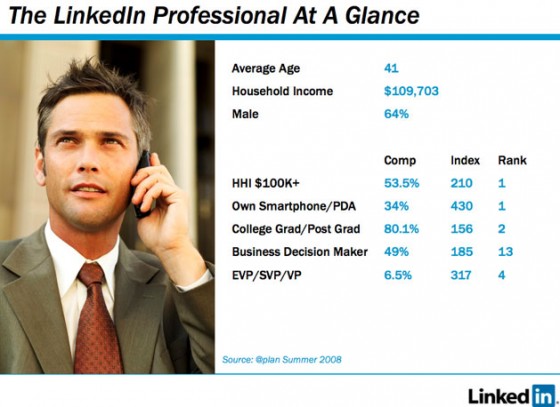
LinkedIn claims 27 million registered users. According to comScore, 5.2 million from the U.S. visited the site in July (8.7 million worldwide). LinkedIn claims that the average household income of its members is $110,000, 64 percent are male, the average age is 41, and 49 percent are decision makers. (In contrast, the average Wall Street Journal reader, according to LinkedIn, makes $102,000 per household, is 48 years old, and only 40 percent are business decision makers).

LinkedIn already sells ads against this audience on its own site, targeted by industry, seniority, company size, geography, gender, and number of connections. Now, it will expand that targeting to other partner sites. Publishers will have to apply to become part of the ad network, but LinkedIn will probably try to sign up some of its existing content partners such as the Businessweek, CNBC, and the New York Times.

Whenever someone visits LinkedIn, a cookie will be placed on their browser, which will identify them as a LinkedIn member when they visit a partner site. Personally identifying information will be removed, but members will be grouped into different, targetable categories. As with Yahoo and Google’s similar ad-network targeting, anyone will be able to opt out of this program.

It is becoming increasingly obvious that the social networking game is not just about who has the largest audience, but also about who has the most valuable audience. The dominant social networks like MySpace try to maximize advertising dollars by focusing on the most lucrative geographic markets.

LinkedIn knows it has a valuable audience, and now wants to sell access to that audience to others. Although LinkedIn will always make more money off the ads it shows on its own site (since it doesn’t have to split those ads three ways with Collective Media and the partner sites). Perhaps LinkedIn realizes that it will never become a big enough site on its own to justify its recent $1 billion valuation. (Although employees can only sell shares at a $500 million valuation). This will create incremental revenues for LinkedIn. And for publishing site partners it offers a potentially more lucrative set of remnant inventory that it can throw ads up against.

Is this the future of all destination sites—to become ad networks and sell their audiences everywhere to the highest bidder?

get widgetminimize
LinkedIn image
Website: linkedin.com
Location:Mountain View, California, United States
Founded: May 1, 2003
Funding: $80.5M

With more than 24 million users representing 150 industries around the world, LinkedIn is a fast-growing professional networking site that allows members to create business contacts, search for jobs, and find potential clients. Individuals have the… Learn More

Studie „Research online, purchase offline in der Touristik“

TUI, Google, iProspect und Sempora Consulting initiierten gemeinsam die Studie „Research online, purchase offline in der Touristik“. Aus dieser geht hervor, dass sich immer mehr Kunden über ihre geplante Urlaubsreise im Internet informieren, bevor sie diese dann im Reisebüro buchen. Research online, purchase offline, abgekürzt ROPO, nennen Marktforscher dieses Verhalten.

Laut Studie hat der ROPO-Markt in Deutschland ein Volumen von mittlerweile fast sechs Milliarden Euro. Das sind gut ein Viertel des Umsatzes des gesamten touristischen Kernmarktes. Nur sieben Prozent des Marktes gehen den umgekehrten Weg vom Reisebüro ins Internet.

Der online informierte Kunde hat bei der Recherche jedoch fast immer das Gefühl, dass der Besuch im Reisebüro ergiebiger sei. Für 52 Prozent ist der Besuch sogar deutlich ergiebiger, 32 Prozent empfinden ihn als etwas ergiebiger, lediglich 16 Prozent geben an, der Besuch sei genauso ergiebig.

iProspect Geschäftsführer Ronjon M. Sarcar: „Angesichts dieser Ergebnisse sollten sich Unternehmen darüber im Klaren sein, dass ein wichtiger Teil ihrer Marketing-Aufwendungen im Internet zu mehr Umsatz im Reisebüro führen.“ Thomas Golly, Partner der Unternehmensberatung Sempora, fasst zusammen: „Die schiere Größe und Dynamik von ROPO zeigen deutlich, dass nun kanalübergreifende Vermarktungskonzepte gefragt sind, um aus ROPO auch nachhaltige Wettbewerbsvorteile ziehen zu können.“

Für die Studie wurden 20.000 Privathaushalte durch das GfK-Travelscope-Panel befragt, 539 Reisebüro-Bucher, die sich vorher online informiert hatten, wurden interviewt, und bei 382 Buchern (on- oder offline) ist das Online-Verhalten per Browser-Plug-in untersucht worden.

BOTW In Talks To Purchase DMOZ Directory From AOL

Jeremy Schoemake


At SES San Jose a couple weeks ago there were rumors floating around about Best Of The Web purchasing DMOZ from AOL. I am very good friends with the owners of BOTW and when I asked them during that time they told me “officially” they had no comment.

Well I have been pressing them a bit more about an official word regarding the purchase. AOL has been dumping a ton of dead weight and being BOTW has already hired away most of the premier DMOZ editors it just seemed like a good fit for them.

Well I now have official confirmation that BOTW and AOL are in discussions about selling the directory and a deal could be reached fairly soon.

So being that Google’s business directory is just a syndication from the DMOZ I wonder how Google will look on this deal.

I can already see the headlines of “Now You Have To Buy Your Way Into Google’s Business Directory” but seriously…. atleast it will have some editorial standards.

Anyway as I said above I am good friends with the owners of BOTW so obviously I am biased. I am curious to hear your thoughts on the deal if in fact BOTW is the new owners of the DMOZ directory.

Freitag, 12. September 2008

OTA Search Share: Expedia Leading the Way

It’s hard to think of an online consumer offering that doesn’t rely heavily on search, and travel is no exception. With economic factors making consumers more price-conscious than ever, travelers are looking for good deals more and more, making search an integral traffic driver for Online Travel Agencies (OTAs).

Expedia is the class of the industry when it comes to search though, with a 26% share. This means that they receive traffic from just over one out of every four clicks (both paid and natural) to a major OTA from search, followed by rivals Travelocity and Orbitz. Priceline has moved into the fourth position by growing its share by nearly 5%, replacing Cheaptickets, which has fallen by almost the same percentage.

Taking a deeper look at paid search traffic specifically, we see that 36% of all search traffic to OTAs comes through sponsored links. Hotels.com leads the way with an average of 44% of search referrals coming from paid search. Expedia is in the advantageous position of being on the lower end of paid search percentage ((34%), despite having such a large search share.

With ever increasing ROI expectations being placed on travel marketers, optimizing the online channel is critical. Given that many of the OTAs are relying more heavily on paid search referrals, and the degree of volatility in this space, it would benefit the OTAs to closely monitor share of search traffic across the competitive landscape.

Online Brokerage Sites See Increased Visitors with Ramped Up Online Advertising Efforts

Despite a softening economy – or, perhaps, because of it – the overall number of visitors to online brokerage sites grew 14 percent during the past year, more than twice the rate of growth of the total U.S. Internet audience. Despite recording a 9 percent decline in visitors, Fidelity Investments still led the category with 3 million visitors in June 2008, followed by Scottrade Sites (1.6 million visitors) and E*Trade Financial Network (1.2 million visitors), both of whom showed strong growth in unique visitors.

Selected Online Brokerage Sites*

June 2008 vs. June 2007

Total U.S. – Home/Work/University Locations

Source: comScore Media Metrix

Total Unique Visitors (000)

Jun-2007

Jun-2008

% Change

Total Internet : Total Audience

178,839

189,873

6

Online Trading

10,553

12,079

14

Fidelity Investments

3,302

3,018

-9

Scottrade Sites

1,255

1,585

26

E*Trade Financial Network

1,096

1,226

12

TDAMERITRADE.COM

1,066

1,108

4

SCHWAB.COM

821

719

-12

TROWEPRICE.COM

324

338

4

ZECCO.COM

N/A

160

N/A

TRADEKING.COM

N/A

71

N/A

*List includes only selected sites in the Online Trading category and does not constitute an official category ranking

“Though it may seem counterintuitive, an economic downturn actually represents an opportunity for companies in the financial sector because consumers are more engaged with their finances. The increase in visitors to online brokerage sites during a weakening stock market reflects this reality,” said Brian Pugh, comScore Director of Financial Solutions. “Because consumers may be more open to brand switching if they see a chance to save money or mitigate financial risk, financial service companies should seek to capitalize on the opportunity. One way online brokerages have attempted to do so is by increasing their investments in online advertising.”

E*Trade and Scottrade Lead Online Advertising Efforts

Among online brokerages with a significant paid search strategy, E*Trade.com led with 6.4 million paid search ad impressions in June. E*Trade.com has consistently led the competitive set since the beginning of the year and has been widening its lead versus the rest of the group. Also notable is that the two newest online brokerage sites in the competitive set, Zecco and Trade King, have pulled ahead of T. Rowe Price in their paid search link exposures, indicating a significant early push in the SEM acquisition channel.

Selected Online Brokerage Sites

June 2008

Total U.S. – Home/Work/University Locations

Source: comScore Marketer

Advertiser

Paid Search Link Exposures

(000)

Share (%) of Paid Search Link Exposures*

Total Unique Searchers (000)

Average Frequency

E*Trade

6,390

31.7%

2,846

2.3

Scottrade

3,546

17.6%

1,588

2.2

TD Ameritrade

3,198

15.9%

1,533

2.1

Charles Schwab

3,036

15.1%

1,249

2.4

Fidelity Investments

2,133

10.6%

1,005

2.1

Zecco

1,127

5.6%

593

1.9

Trade King

541

2.7%

264

2.1

T. Rowe Price

191

1.0%

108

1.8

*Share based on competitive set of 8 selected online brokerages

Scottrade, ranking second among online brokerages in paid search link exposures, was the top display advertiser in June with more than 1.2 billion ad views, followed by E*Trade (549 million ad views), Fidelity Investments (498 million ad views), and TD Ameritrade (314 million ad views). Scottrade reached 67.6 million people with its display ads, representing more than one third of the total U.S. Internet audience.

Selected Online Brokerage Sites

June 2008

Total U.S. – Home/Work/University Locations

Source: comScore Ad Metrix

Total Display Ad Views (000)

Share (%) of Publisher Ad Views*

Advertising Exposed Unique Visitors (000)

Average Frequency

Scottrade

1,233,110

45.5%

67,598

18.2

E*Trade

549,405

20.3%

60,692

9.1

Fidelity Investments

498,329

18.4%

40,345

12.4

TD Ameritrade

313,808

11.6%

33,208

9.5

Zecco

59,896

2.2%

6,945

8.6

Trade King

25,537

0.9%

1,494

17.1

Charles Schwab

19,796

0.7%

3,617

5.5

T. Rowe Price

8,433

0.3%

2,724

3.1

*Share based on competitive set of 8 selected online brokerages

“Scottrade and E*Trade are the category leaders in terms of having the heaviest online advertising plans,” added Mr. Pugh. “However, recent entrants Zecco and Trade King are investing in their own online advertising efforts and may eventually prove themselves to be important competitors in this market.”