Mittwoch, 17. Dezember 2008

AdWords Editor Version 7 - ist da!

neue Features:
• ”Geschätztes Gebot zur Schaltung auf der ersten Seite”: Statt des min CPCs zeigen wir jetzt für jedes Keyword das “Geschätzte Gebot für die erste Seite” an. Der min CPC wird nicht mehr angezeigt.
• Keyword Qualitätsfaktor: Im Keyword Tab wird der Qualitätsfaktor jedes einzelnen Keywords angezeigt
• Keyword Manager: Anpassung der Keyword Vorschläge auf eine spezielle Sprache und Region
• Kampageneneinstellungen: Sie können Ihre Ausrichtungseinstellungen in den neuen “Sprachen” und “Regionen” Spalten sehen. Sie können die Spalten mit Hilfe der Spaltenauswahl auswählen.
• Senden Sie Ihr Feedback zu Google: Helfen Sie uns, den AdWords Editor zu verbessern und erlauben Sie das automatische Tracken Ihres Nutzerverhaltens. Gehen Sie auf Tools - > Settings.
• Im Keyword Manager können Sie jetzt analog zum Keyword-Tool im Online-Konto absolute Suchanfragen sehen (Daten des jeweilig letzten Monats)


von google 1:


von google 2:

We'd like you to be the first to know that we just released AdWords
Editor 7.0. Here are a few highlights:

- AdWords Editor now displays keyword Quality Scores and first page
bid estimates. This information is displayed on the 'Keywords' tab,
and it's integrated with tools like advanced search and advanced bid
changes. For example, you can raise multiple keyword bids to their
first page bid estimates by following these steps:
http://www.google.com/support/adwordseditor/bin/answer.py?answer=115770

- With the new usage tracking feature, you can automatically send our
product team anonymous data on activities (like the tools you access)
to help us improve AdWords Editor. To learn more about the feature,
including privacy questions, please visit this article:
http://www.google.com/support/adwordseditor/bin/answer.py?answer=114997

- In the Keyword Opportunities tool, you can now tailor your results
to a particular language and location:
http://www.google.com/support/adwordseditor/bin/answer.py?answer=115344

An important note about upgrading:

You will need to download your account again after upgrading to
version 7.0. To save your comments and unposted changes, click 'Backup
then Update' when you see the automatic prompt to upgrade. AdWords
Editor will create a backup file that includes your comments and
unposted changes. Then, after you've installed the new version, import
the backup file by following the steps at
http://www.google.com/support/adwordseditor/bin/answer.py?answer=38667.
If you'd prefer to upgrade later, click 'Don't Update' in the prompt.

To see what else is new in version 7.0, please visit our release
notes:
http://www.google.com/support/adwordseditor/bin/static.py?page=releas...

IGEDO sagt Online Marketing Düsseldorf ab

Vollkommen überraschend für Aussteller und Branchengrößen gab die Messegesellschaft heute das Aus für die Online Marketing Düsseldorf bekannt. Und das nach einer sehr positiven Bilanz für 2008. Die IGEDO-Verantwortlichen waren wohl nicht mehr zu den Investitionen bereit, die eine Behauptung gegen den Wettbewerber Dmexco in Köln erfordert hätten.
Offiziell heißt es "der Düsseldorfer Messeveranstalter Igedo Company wird sich im Zuge einer Neuausrichtung seiner Unternehmensstrategie zukünftig ausschließlich auf ihre Kernkompetenz 'Modemessen' konzentrieren." Die Entscheidung wurde am gestrigen Dienstag auf einer Gesellschafterversammlung beschlossen. Am heutigen Spätnachmittag kommunizierte die Igedo die "Absage der online marketing düsseldorf 2009" gegenüber den vollkommen überrumpelten Ausstellern und der Presse.

Seit 60 Jahren veranstalte die Igedo Company erfolgreiche Modemessen, erklärte Herbert Vogt, Vorsitzender der Gesellschafterversammlung. "Dieses Asset wollen wir in Zukunft weiter stärken und erachten es aus diesem Grunde als wichtiger, die durch die Absage frei werdenden Ressourcen für die Weiterentwicklung der Igedo Fashion Fairs Düsseldorf zu nutzen", so Vogt.

Ein Insider kommentiert diesen Zug als "Rückwärtsgewandheit der Messe. Die konzentrieren sich auf Mode, statt auf eine zukunftsweisende Branche". Dagegen waren am Ende der diesjährigen Messe von der Messegesellschaft noch steigende Buchungen und die Messetermine für die kommenden Jahre verkündet worden. Zuletzt gab es offiziell 40 Buchungen - nach Gerüchten hatten sogar fast 50 Firmen zugesagt. Das ist zwar mehr, als die Düsseldorfer in vergangenen Jahren zu diesem Zeitpunkt in den Auftragsbücher stehen hatten - allerdings rechnete die Messeleitung wohl nicht mehr damit, dass sich die Zahlen auch im weiteren Verlauf ähnlich positiv entwickeln könnten. Zu viele Unternehmen hatten sich bereits für den Wechsel nach Köln entschieden - und darunter sehr viele der quadratmeterstarken Beteiligungen.

Vollkommen überrascht ist BVDW-Geschäftsführerin Tanja Feller. Sie erfuhr von der Absage an die OMD durch die Anfrage der iBusiness Redaktion. "Der BVDW hat zwar ein Votum für Köln abgegeben. Aber wir haben die OMD dennoch akzeptiert und sind von der Entscheidung der Igedo überrascht", so Feller gegenüber iBusiness. Im April 2008 hatte der BVDW der Branchenleitmesse OMD überraschend seine Unterstützung versagt und wird im kommenden Jahr mit der Kölnmesse eine Konkurrenzveranstaltung Dmexco etablieren.

Der OMD-Chef Alexander Felsenberg hatte darauf hin immer wieder erklärt, dass "die Online-Marketing-Düsseldorf auf jeden Fall weiter macht." Außerdem standen die OMD-Termine bereits bis 2013 fest. Die neue Konkurrenz-Veranstaltung habe die Zielgruppe Mediaeinkäufer, die OMD hingegen vertrete "die ganze Onlinewerbebranche", verdeutlichte Felsenberg. Die OMD wolle sich anderen Teilbranchen öffnen und Gespräche mit den Auftraggeberverbänden führen, "um die Anwender in die Veranstaltung zu bringen. Der Fokus der OMD heißt Onlinemarketing, nicht mehr nur Onlinevermarktung", so Felsenberg kämpferisch. Der Zuspruch der Messe sei sowohl national, als auch international enorm gewesen. Und in diesem Jahr war die OMD erfolgreicher denn je.

Obwohl die diesjährige OMD mitunter einige Erwartungen übertraff und die Bilanz auf eine positive Zukunft deutete, musste die Messe bereits einige Rückschläge hinnehmen. Die neu aus der Taufe gehobenen Konkurrenzmesse Dmexo hat beispielsweise noch auf der OMD eine Liste mit 20 Ausstellern präsentiert, die im kommenden Jahr definitiv in Köln vertreten sein werden. Erklärte Strategie: "Die Dmexo soll die europäische Leitmesse werden".

380 Aussteller und mehr als 20.000 Besucher zählten die Veranstalter 2008, was einem Wachstum von 44 Prozent entspricht. Zudem konnte die OMD in diesem Jahr eine Messehalle mehr eröffnen. Die Besucherzahlen und die Stimmung bei den Ausstellern auf der Messe zeigten, dass das OMD-Konzept voll aufgegangen sei, freute sich Felsenberg noch im September.

Nun hat sich das Blatt gewendet und der Dmexo, als künftige Leitmesse für das digitales Business, steht momentan nichts mehr im Wege. Alexander Felsenberg war bis Redaktionschluss nicht erreichbar. (SUR - ibusiness)


und hier nun ofiziell:

online-marketing-düsseldorf


Kontakt


Igedo Company
GmbH & Co. KG
Messeplatz
D-40474 Düsseldorf
T +49.211.43 96 519
F +49.211.43 96 525
wilhelms@igedo.com


Abschied von der online-marketing-düsseldorf

Mit großem Bedauern geben wir die Absage der online-marketing-düsseldorf 2009 bekannt. Damit wird das letzte Kapitel einer beispiellosen Erfolgsgeschichte der Leitmesse für digitales Marketing in Deutschland geschlossen. Die Igedo Company konzentriert mit dieser Entscheidung künftig alle Kräfte im Bereich "Modemessen" – der eigentlichen Kernkompetenz des seit fast 60 Jahren international tätigen Messeveranstalters.

Trotz der erfolgreichsten online-marketing-düsseldorf aller Zeiten mit mehr als 20.000 Besuchern und 380 Ausstellern im Jahr 2008 war dieser Schritt unumgänglich.

Wir danken allen Besuchern für ihr überragendes Interesse und ihre Begeisterung. Wir danken allen Ausstellern der vergangenen Jahre für die Flut an Innovationen, die die online-marketing-düsseldorf zu einer von allen Teilen der Branche anerkannten, zukunftsweisenden und faszinierenden Leitmesse für digitales Marketing gemacht haben. Unsere Wertschätzung gilt insbesondere allen Partnern und Ausstellern, die uns bis zuletzt ihr Vertrauen und ihre Unterstützung entgegengebracht haben. Es hat uns viel Freude gemacht, mit Ihnen zusammenzuarbeiten.

Wir wünschen Ihnen und Ihren Familien ein friedvolles Weihnachtsfest und einen guten Rutsch ins neue Jahr!

Das Team der Igedo Company

AdWords Landing Page Quality Refresher

“Everyone has a plan until they get punched in the mouth.” This gem from heavyweight boxing legend Iron Mike Tyson also applies to AdWords account strategy, especially when starting a new account.
Beginning in 2006, some advertisers in the affiliate marketing, Made-for-AdSense, and other spheres have referred to harsh quality score treatment — especially treatment caused by poor landing page and website quality scores — as the “Google Slap.” But “slap” was never the appropriate terminology. I know Google won’t like being compared with Mike Tyson, but it’s the only analogy I have in the jar. So, let’s be clear. Slaps are for sissies. If your landing page and website quality are really bad, you’ll probably take a Google Punch in the mouth. With regard to landing page quality score hits on your keyword quality scores, “it tends not to have a small impact,” Nick Fox, Director of Business Product Management (and a primary architect of the Ads Quality system), told me in an interview last week. When it comes into play, “it usually causes a fairly significant hammer in an account,” he added.
Most advertisers don’t even need to worry about landing page and website quality (LPAWQ), other than staying reasonably vigilant about certain guidelines for disclosure, clean navigation, and page load times. Iron Nick Fox isn’t about to go through the ropes, wading into the crowd of respectful, paying customers, and begin biting people’s ears off. There are rules here!
The coiners of the term Google Slap, unfortunately, have now begun spreading misconceptions about the role landing page and website quality plays in the overall weighting of factors that result in your keyword quality score, which ultimately (along with your bid) affects your ad’s eligibility to show against a given keyword, and its rank on the page. Higher quality scores help you maintain high ad positions for less money — a phenomenon which is essentially unchanged since 2002.
Refresher: landing page and website quality
For quality score, Google currently considers click through ratio (CTR) and several other factors. CTR continues to be weighted very heavily, especially as a CTR history builds up in your account as a whole, for display URL’s in your ads, and most of all, for a particular keyword. Alongside CTR, Google is looking at other signals, such as predictive data that builds on the knowledge base Google has about user responses to various types of keywords. Along with assessing whether your keyword is “really” relevant to your offer, it’s likely the system assesses commercial intent. Keywords that are nearly always searched by users looking for non-commercial information may not ever reach the highest pinnacle of quality score (Google’s scale now is 1-10, and all keyword quality scores can be looked up in your AdWords account). But essentially this is the auction working as it always has with CTR doing a lot of the heavy lifting, with some refinements added by Google to tune search results pages for increased user satisfaction (fewer irrelevant ads showing up).
In my interpretation, it’s useful to see landing page and website quality as a whole different thing. As Nick pointed out, small changes in your pages aren’t likely to affect your keywords’ quality score. In fact, in the majority of cases, Nick reports, the impact of landing page and website quality score on your keyword quality scores is “essentially none.”
Now, confusion is being introduced into the marketplace by the Google Slap Fixers. They tell you they have a whole system for upping landing page relevancy like by creating a great many pages for each individual keyword. Do you think Google is fooled? I doubt it.
Unfortunately, the purveying of page-creation solutions to marketing communications problems has now spread to respected SEO’s who think they can introduce 1998-era solutions to 2008 paid search problems. Have they read Google’s documentation about ad quality? More to the point, have they built and improved any significant number of AdWords accounts for conventional business clients?
The more people in the industry talk about landing page and website quality, the easier it is for advertisers to be seduced by the notion that testing and tuning landing pages will funnel a quality score benefit back into your account. But that’s just not the case. Nick Fox’s take, again from last week’s interview, is that it isn’t really feasible or informative to run landing page tests specifically for the purpose of discovering their impact on keyword quality scores. While keyword quality scores are refreshed constantly and are in fact determined in real time in a query-contextual fashion (and reported in your account as aggregates), landing page and website quality score updates are infrequent.
Moreover, does Google break out the actual scores, or describe the scoring system, for landing page and website quality? No. Instead, you can view either a green checkmark or a red X for LPAWQ in the account detail on any given keyword. The same goes for a separate quality issue, landing page load times. So for now, it’s very much a “black or white” (or green or red) phenomenon. Nick Fox refers to the LPAWQ effect as “quite binary.” He also remarks: “It tends to be more of a business model thing.” Translation: you can’t A/B test your way out of a deliberate punch in the mouth.
Pattern matching
According to Nick, Google uses a “regression type approach” to look at how a “variety of signals interact with one another” in terms of on-page factors and user responses to pages and websites over time. Google’s system looks at pages and sites on an ongoing basis (especially in the early stages of account ramp-up), and if their characteristics match the patterns of the prohibited kinds of sites and pages, they pick yours out of the proverbial lineup and assign low quality scores. In such cases, the impact is usually fairly serious, and it will affect your ads’ eligibility to show up, and/or cause you to have to bid more (way more in some cases) to show up on the first page of search results.
Think you can fool the system? Maybe it’s possible. But there is probably human oversight combined with the data. There might even be editorial notes and flags placed on accounts. You won’t see that. When you get the silent treatment from Google reps, it may mean they don’t think the account has much potential to be greenlighted because, in their view and backed up by certain data, you’re a willful violator of their Landing Page and Website Quality Guidelines.
Low quality scores? Find out if it’s the landing page
If you have a poor quality score of, say, 3 on a given keyword, you can easily drill down for more information to see if LPAWQ is the culprit.
In your AdWords account, first you will want to be showing quality score in the keyword list of any given ad group. It may be hidden by default. There is a drop-down to “show” quality score.
If one is poor, you can click the magnifying glass icon and the exact score will come up. From there, click again, and a page of additional information will be displayed. This should tell you whether the issue is with keyword relevancy or LPAWQ. Admittedly, the textual explanations are boilerplate. But if there is a big green checkmark showing for LPAWQ, then that isn’t your problem.
User engagement metrics?
User engagement metrics such as time spent, page views, and even conversions are all obviously very interesting from an audience and business standpoint, but they don’t make an AdWords quality score go up because Google is mostly just looking for evidence of significantly negative user experiences in order to treat them punitively. If nothing is particularly wrong, you’re greenlighted.
As such, you should undertake your website development and response testing efforts for business or audience reasons, with no expectation that those worthy experiments will funnel back into your keyword quality scores.
I’ll explore this aspect in more depth in a future column.
The AdWords Quality Score system is far from transparent. But I hope the above summary counters some of the mythology currently in circulation. Advertisers should focus on core relevancy and targeting techniques, close major performance gaps in accounts, and worry less about the impact of landing pages on keyword quality scores.

Small Businesses Struggle With Search Marketing

Microsoft just released results of a survey of 400 small businesses (SMBs) that shows they continue to struggle with search marketing (how to think about it, how to do it). This is consistent with what I and others have observed about the majority of SMBs, even those with websites. The search engines want to reach this massive market directly but have found it very difficult to do so without working with established sales channels and partners (newspapers, yellow pages, webhosts, etc.) that have existing SMB relationships. That can be problematic in some cases because the various revenue sharing agreements diminish the available funds for a paid search buy (but that’s a lengthy topic for another time).

First some context. Here’s a breakdown of US businesses by headcount according to US Census data:

Source: US Census (2004)

All but a tiny fraction US businesses have less than 100 employees. Most have fewer than four.

Now back to what the Microsoft survey found:

  • The study revealed that 59 percent of small businesses with Web sites don’t currently use paid search marketing, and of those, 90 percent have never even attempted it.
  • Nearly nine in 10 (89 percent) feared keywords may become too expensive.
  • Eighty-one percent questioned if paid search marketing is the best use of their marketing budgets.
  • One quarter of respondents believe paid search marketing is too complex.
  • Twenty-one percent thought it would be too time-consuming.
  • Thirty-five percent felt they would need an agency to help set up a search marketing campaign.

Opus Research recently found in an earlier SMB advertiser survey (n=1089, 8/08), among SMBs who did no online marketing, the main reason was confusion:

Source: Opus Research, AllBusiness.com (2008)

This is “online marketing” in general and not search per se. But the findings, as the Microsoft data suggest, would be magnified for search among those not doing it. However the same Opus survey found that paid search was cited as the third most effective marketing method among a list of 15 media types, after email marketing and print newspapers. So those doing it have seen its value presumably.

Yet even among those SMBs that are doing search marketing, many are doing it in ways that diminsh the effectiveness of their spend. SEM platform provider Clickable found that more than 50% of 1,000 SMBs on its platform failed to implement conversion tracking and were thus wasting some of their budget by not really gaining insight into the true ROI of their keywords.

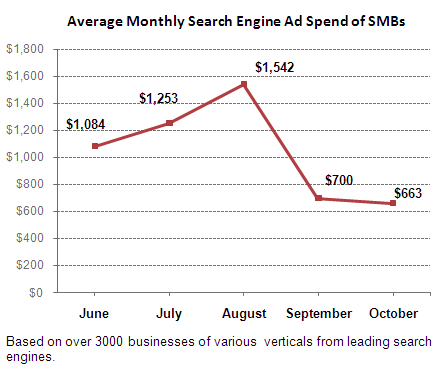
While progressive SMBs and “e-tailers” were among the first to adopt paid search as a direct response medium, the majority of small businesses are mystified by the mechanics — the “how” — of search and need simple tools and/or third party help. Yet their spend is such that it may be hard for a third party without a substantially automated/scalable platform to build a sustainable business model around it. For example, Palore recently found the following about the average paid search spend of certain categories of SMBs:

Source: Palore

But there are other data that show an even smaller monthly spend. The volume is great, but the spend is relatively low. Unless or until the engines can provide an even more simplified way to do paid search they’re unlikely to acquire large numbers of additional SMB advertisers, except through complex third party relationships. (Google “simple ads” has yet to appear.)

Thus for SMBs and search engines there will likely continue to be challenges and frustration — on both sides — for at least the foreseeable future.

Google Tests a Different Search Links Design


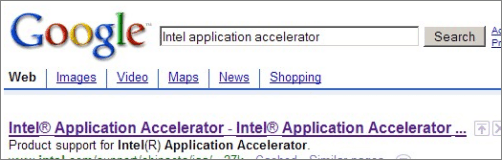
Zim has spotted what looks like one of Google’s experiments, rolled out to only a portion of users for some time. In the screenshot you can see a line between the top suggestions like “Web”, “Images”, “Video” and so on (besides the clearer separation, this is also a more complete selection of related links than what I’m getting when I search for this term).

Omniture Brings Real-Time Analytics To iPhone Applications

(F..k!!! hab ich doch vor monaten schon mal gesagt, dass die franzacken dies als client eyecandy für c2s basteln könnten *gmpf*)


by Robin Wauters

Omniture is extending its SiteCatalyst measurement tool to native iPhone applications, enabling developers and marketers to gain insight on how users are interacting with their iPhone apps, based on real-time information. This should allow them not only to improve the user experience based on analytics, but also make adjustement necessary to generate more revenue by enhancing ad clicks, purchasing and increasing page views.

The new offer, which is basically an extension of its existing SiteCatalyst solution, is called App Measurement for iPhone and will be generally available as from January 2009. To our knowledge this is the first analytics program specifically designed for native iPhone applications, but it’s safe to say other providers will soon follow suit with similar offerings.

Update: that’s why we love commenters. Venture-backed Pinch Media also offers an analytics suite for iPhone developers.

Update 2: similar service providers include Medialets, Mobilytics, AppLoop and Mobclix.

In related news, Tel Aviv-based Kenshoo is taking its Search Engine Marketing campaign management solution mobile, enabling users to consult campaign statistics and reports from their iPhone browser. More information about their solution is available here, and a video demo can be viewed here.