Consumers trust company blogs less than any other channel.
This result comes from a survey we did in Q2 of 2008. Have a look at the data yourself. Not only do blogs rank below newspapers and portals, they rank below wikis, direct mail, company email, and message board posts. Only 16% of online consumers who read corporate blogs say they trust them. If you’re a corporate blogger or somebody who advises companies, you need to take this into account.
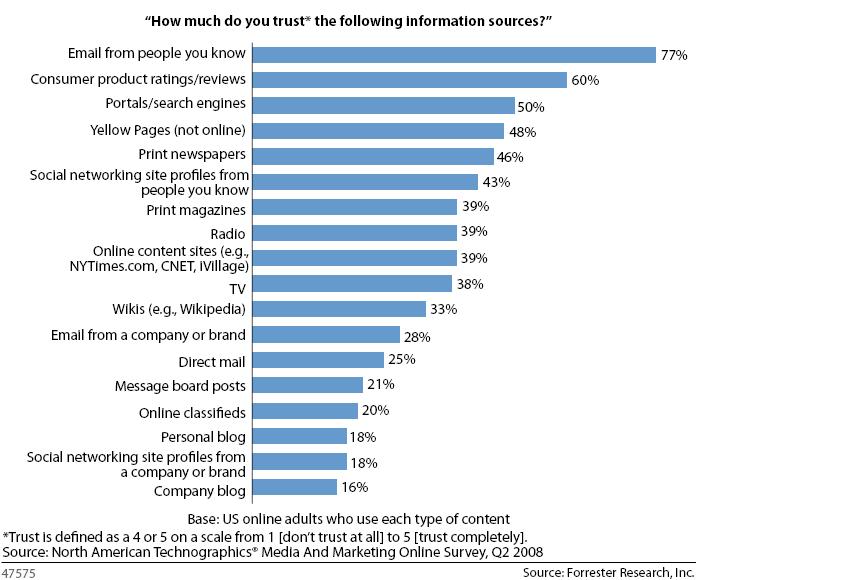
For our clients, the full report is here. If you're a marketer who would be interested in this report, you can download it after you register here.
Now I suspect this report is going to generate a lot of discussion in the blogosphere, and it’s easy to misinterpret. So please, humor me and read the rest of this post before you write your own take on this. If you’re interested in the way we collect data, that’s at the end.
We examined these results further. Among people who regularly read blogs (at least once a month), 24% trust company blogs. Among people who blog themselves, 39% trust them. These are low numbers any way you slice it.
In fact, those who trust company blogs are the most trusting of all consumers. Not only do they trust blogs more than average consumers, they trust everything more. Your blog isn’t winning over many skeptics, folks.
In retrospect this result is not that surprising. People don’t trust companies in general. Why should they trust a company blog any more than a press release or an advertisement?
So, what should you do about this?
Make no mistake. This is not a plea to give up on blogging.
It is a plea to be thoughtful in how and why you blog.
This means that if you blog, your goal should be to create a blog about which people say “I like that – I don’t think of it as a company blog.” For the most part, that’s a hurdle you need to jump to gain their trust. I don’t mean to hide who is writing the blog. I mean it has to be more about your customers than it is about you.
Blogs exclusively about companies and products are what I think generate these low trust ratings. So don’t do a blog like that.
Instead, adjust your strategy based on your objectives. (Sound familiar?)
If you want to be a thought leader and helper for your customers, and you blog frequently about those customers’ problems and solutions, then you can generate trust. This takes time and effort, but it will enhance your company’s reputation and it’s worth it. Want an example. Check out Rubbermaid’s blog.
If you have created a community for your customers, your company needs a voice in that community. A blog is a natural way to meet this need.
If you have hordes of fans, blog for them. This is great if you are Harley Davidson or Apple (which, ironically, have has no company blogs). For the other 99% of brands it doesn’t apply.
You can also blog, or Twitter, just to be on the record about your company. This is fine; Motrin could have benefited from this strategy. But if you do this, just recognize that you’ll be playing defense, and that people in general will not trust you.
So, right at the moment when companies are getting ready to join the groundswell, I’m telling them to stop and think. Always a good idea before taking a step into the melee, wouldn’t you agree?
A note about how we collect data. The data comes from an online survey we conducted in Q2 of this year. Our online panel is as representative as we can make if of the US online adult population (18 and older). Companies use our data all the time, and I believe it’s the best available survey of its kind; we’ve been conducting surveying consumers since 1997. In this case, we surveyed over 5000 people. We asked them to rate how much they trust information sources on a five-point scale, from 1 (don’t trust at all) to 5 (trust completely). Respondents could also answer that they didn’t use a particular information source. In this case about 80% of those we polled said they did use corporate blogs. Of those who used them, only 16% rated them 4 or 5 on the five-point trust scale.
