Sonntag, 25. Mai 2008

private soon again

searchmonkey wird bald wieder private gehen...
gedacht war es als minimal copy & paste blog und nicht als leeching facility.
ich denke 1 - 2 wochen max. und dann werden nur noch poster zugang haben

sorry aber im bizz gibt es zuviele leecher
also das ding hier sollte doch nur copy paste von entdeckten news sein... ist doch kein thema. für nen rumor blog & skill blog habe ich leider keine zeit, (und i h poste seit wochen alleine hier) sorry palls

also einfach strg-c strg-v was ihr interessantes erblickt und alles ist bingo.
jeder der mitmachen will ist willkommen - brauche nur n' account (blogger/gmail) von euch und ihr seit blog-red. hier. pas de problem.

haut rein!
das R

Freitag, 23. Mai 2008

case study: How to Turn Video Contest Into a Viral Extravaganza & Get Millions of Views on YouTube

CHALLENGE
Samer Forzley, Marketing VP, eBillme, needed to create an advantage for the online-shopping brand over its two more established competitors. Previously, when they sought to add more online options for shoppers who prefer paying by cash through their banks, Forzley and his team targeted eretail sites.

For this campaign, they decided to target shoppers instead. They hoped to create a groundswell of recognition among online consumers and encourage eretail prospects to follow them to eBillme’s door. “We needed to do better in terms of bolstering awareness among consumers,” Forzley says. “And we really hadn’t done anything in the social media world up to that point.”

CAMPAIGN
To make shoppers more familiar with the site, Forzley and his team sponsored an online video contest held between October and Christmas 2007. Besides creating as much buzz as possible, they were particularly interested in seeing what a presence on YouTube could do for the brand.

Here are the seven steps they took:

-> Step #1. Decide on theme

Forzley and his team first chose a theme for the contest: ‘Shopping Confessions.’ The concept urged participants to tell on video their ‘dirty little secrets’ about making an online purchase and then hiding it for whatever reason.

-> Step #2. Incentivize potential contestants

Video-making takes real commitment for contest players. So, they incentivized participation in a *meaningful* fashion.

Here are their five prizes:
o $1,000 winners announced on four Mondays -- Nov. 2, 9, 16, and 23 (Cyber Monday)
o $20,000 grand prize given on Dec. 18

-> Step #3. Set participation guidelines

Next, they created easy-to-use guidelines for video makers to follow. “It was important to give how-to instructions and suggest basic guidelines without laying down too many hard-set rules,” Forzley says. “We also wanted them to know what the judges would be looking for.”

Here are their two basic guidelines:
o Video clips run 30 to 60 seconds.
o Entries would not be considered for the grand prize after Cyber Monday.

Here is copy from the instructions page to encourage *the right kind* of submissions:

“Your video will show the world what you bought, who it was for, and why you hid it. Tell us how your secret was finally revealed [or maybe this is the first time it will be]. If you got caught in the act, we want to know what happened and how you tried to get out of it.”

-> Step #4. Establish YouTube group

They set up a YouTube group dedicated to the contest because they wanted an easy-to-develop and inexpensive online destination for the videos. Since this was their first go-round, they weren’t ready to commit to a microsite that housed video uploads.

“Those who would be submitting may already have an audience on YouTube,” Forzley says. “Therefore, it was a logical method of encouraging viral and improving brand awareness.”

Forzley created a URL -- http://www.shopandconfess.com -- as the home for the contest. But all of the videos sat on YouTube’s server.

-> Step #5. Select panel of judges

Racking up viewer votes was important, but they didn’t want to undercut the contest’s credibility by simply allowing mouse-happy visitors to decide the winner. So they picked a panel of judges.

“If someone simply has a large following, sure, they could have brought in an extra 100,000 views to help them ‘win,’” Forzley says. “But, it takes time to create a video. So, we wanted it to be more fair than that.”

The three-person panel eventually chose a winner that wasn’t the most popular. “We got a lot of feedback from other participants who said that the best video won.”

-> Step #6. Define competition criteria

In addition to popularity, criteria for the judges included:
o Creativity
o Production value
o Entertainment value

-> Step #7. Spread the word

They had their PR agency ping dozens of media outlets about ‘Shopping Confessions’ to produce an offline-online word-of-mouth effect.

Among those pitched:
o Reporters and producers for daily newspapers and local TV stations in big markets
o Websites and bloggers that cater to contests
o Subscribers through email to let them know about the contest opportunity

They also ran ads on eBillme.com’s homepage and ShopAndConfess.com. People tapping the ads -- as well as folks clicking through the email to subscribers -- were directed to the YouTube group.


RESULTS
The campaign achieved all the buzz that Forzley says they set out to accomplish and then some. They received 46 video submissions that were strong enough, content-wise, to be considered for the prizes. The submissions were viewed millions of times on YouTube.

Their most-popular submission -- a 50-second clip about a young man’s candy addiction -- received the top spot among “Featured Videos” at YouTube’s homepage for two consecutive days. It alone was viewed 766,000 times.

“We were watching other online video contests going on at the same time by brands much more recognized than us, and they were not getting the same kind of participation or video views. So, we were very happy.”

YouTube was only the beginning in terms of their bang for the buck. They received mentions in 31 media outlets, which helped propel the views achieved at YouTube, Forzley says.

Perhaps, most important, the campaign helped close the ‘awareness gap’ between eBillme and their front-running competitors, while the ROI for the effort -- about $26,000 -- was a clear win, too. “How much would it cost to get the exposure you get on the front page of YouTube for one whole day, much less two?” Forzley asks. “On top of that, that particular video generated more than 2,000 [viewer comments].”

Response to the 2007 contest was so encouraging, in fact, that eBillme is continuing to sponsor “Shopping Confessions” video contests this year with $30,000 in cash and prizes.

Here are the five top PR highlights from the 2007 campaign:

o WGN-TV - They ran three news segments -- the first one being the Nov. 2 winner who was from the Chicago cable channel’s primary market. Then, they ran segments about the winners for both Nov. 9 and Nov. 16, while televising the winning videos.

o Chicago Tribune - They sent a photographer when eBillme showed up for the Dec. 18 grand-prize announcement at the home of the winners in Elmwood Park, Ill. The Tribune then published an article on the 1-minute, 10-second winning entry: “My Plasma TV Shopping Confession.”

o USA Today - The newspaper ran an article on the topic of confessions, mentioning the contest and its URL.

o A-Channel News - This Ottawa-based TV station’s morning news program televised an image of the contest site and the video from the Nov. 2 winner.

o ‘The Daytime Show’ - The TV morning show, which airs in nine mid-sized and major markets, featured the grand-prize-winning video.

TV@ Google Tipps! - die erste Sendung

Search Engine Optimization Through Hoax News

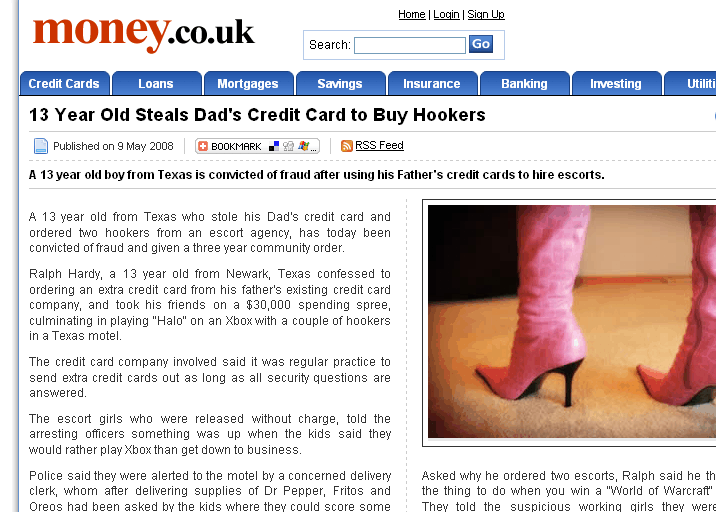
Over at Search Engine Land’s Sphinn, people are discussing a search engine optimization tactic which tries to assemble backlink juice by posting a fake news article. Jonathan Crossfield wraps it up: “Online marketer Lyndon Antcliff recently helped a client achieve over 1500 inbound links in under a week with a story designed to grab attention.” The article, titled “13 Year Old Steals Dad’s Credit Card to Buy Hookers,” was and still is hosted at the authoritative looking domain Money.co.uk, which is a financial advisor and Lyndon’s client, apparently. The hoax news explains that “Ralph Hardy, a 13 year old from Newark, Texas confessed to ordering an extra credit card from his father’s existing credit card company,” taking his friends on a $30,000 spending spree “culminating in playing ’Halo’ on an Xbox with a couple of hookers in a Texas motel.”

Jonathan continues to explain that the page received 2,452 votes at social news site Digg.com (it’s currently at 2,489 diggs, and not marked as incorrect, attracting comments like “Ballsy kid.”). Then, mainstream news made it into the mix. The hoax item was covered in Australia News.com.au, The Daily Telegraph, Fox News and many others, Jonathan says, and even reached the print version of UK’s Sun newspaper.

Google’s Matt Cutts makes a statement

Google’s anti webspam worker Matt Cutts at Sphinn gets involved too, making a statement in regards to the question “Where does [Cutts] and search engines stand on something like this?”. Matt argues, “My quick take is that Google’s webmaster guidelines allow for [as in “cover”] cases such as this,” citing the bit at the guidelines which reads “Google may respond negatively to other misleading practices not listed here (e.g. tricking users by registering misspellings of well-known websites). It’s not safe to assume that just because a specific deceptive technique isn’t included on this page, Google approves of it.” Matt Cutts says, “There’s not much more deceptive or misleading than a fake story without any disclosure that the story is hoax.”

I wonder if it should be any of Google’s business when a page games humans – and whether it should only be of their concern when a page games Google. Otherwise, Google risks becoming an editor for the web, additional to their existing strong traffic channeling power. In that role, they would have to decide what is correct reporting and what is not. In that role, Google would need to answer a lot of new questions, and they may not always be the most qualified to answer them.

For instance; should popular sites like The Onion, which claim to be “America’s Finest News Source,” be judged as deception or satire? What if search engine abusers simply disclaim their own hoax news as satire somewhere on the page? And what happens to news sources which some people would consider so badly researched or sensationalist that one may argue it borders on a hoax? What if the hoax has a bit of truth in it? Is hoaxing allowed on April 1st? Are April 1st articles allowed to reside on the server after the day, without disclosure? What about sites publishing fiction?

Once before, Matt Cutts argued that he thinks “of ’linkbait’ as something interesting enough to catch people’s attention, and that doesn’t have to be a bad thing. There are a lot of ways to do that, including putting in sweat-of-the-brow work to generate data or insights, or it can be as simple as being creative. You can also say something controversial to generate discussion”. (That last tactic, he argued, “gets tired if you overuse it, though”.)

As one example of a backlink-generating tactic that falls into the “generate controversy” camp, Matt Cutts lists Google-critical site Google-Watch.org. Incidentally, one of the theories of that site, Matt Cutts some years ago called “100% wrong”. That would make it similar to a hoax, it seems – and following Matt’s argument provided at Sphinn, that might make it a case which the webmaster guidelines may cover. As you can see, such editorializing would not only be tough and walking many gray areas... it could also start to become a conflict of interest for Google.

Keeping spam out of Google’s results

On the other hand, the fake article in question is also apparently search engine optimization spam – linking out to such heavily rank-battled topics like insurance, mortgage and loans, and perhaps using the word “credit card” in the title of the story just to increase keyword relevancy of backlinks towards this phrase. As a human editor, that convinced me to link out to the site using the “nofollow” attribute. So while it targeted human visitors to add manual backlinks, the real goal seems to have been gaming Google; as such, it may be in Google’s area to unspin the result ranking. Taken to the extreme, a Google search result filled with hoax articles becomes useless – unless someone is specifically looking for hoaxes.

Though – didn’t Google always state they rely on the democracy of the web to decide such things? The PageRank algorithm, which Google say is “the heart” of their software, relies on – according to Google – “the uniquely democratic nature of the web by using its vast link structure as an indicator of an individual page’s value.” If the democracy makes a bad decision – in this case, by having many of its web citizens misjudge the quality of a news item – is it Google’s job to jump in to overrule that decision?

Well, already, Google lets human editors decide which publishers make it into Google News, which in turn are displayed in some of Google’s main search results as News onebox. Also, Google already has human evaluators which indirectly affect rankings – as they can influence which ranking algorithms Google picks (even when Google argues the “beliefs and preferences of those who work at Google, as well as the opinions of the general public, do not determine or impact our search results”) –, and those human evaluators may give lower ratings to search result pages which put hoax stories in higher positions. And then there’s pages employing phishing or distributing a virus; in such cases, Google currently may display a warning in the search, but that flag perhaps does not affect the ranking and the page is still displayed.

Similar to the controversy around how Google expanded their fight against paid links via the push of the “nofollow” attribute (and lowering the PageRank of those who buy and sell links), if the “fake news” SEO tactic becomes more widespread, Google’s response to it may also trigger new discussions. Admittedly – if the nofollow discussions are any indicator, then while there may be lively debate around the topic, at this time it’s Google who makes the final decision. They may listen to webmasters and get involved, but in the end they won’t rely on just democracy or automation, but may come to an entirely human conclusion somewhere inside the Google headquarters.

Lyndon Antcliff removes his coverage of his hoax strategy

In the meantime, search engine optimizer Lyndon Antcliff, who started the hoax item, removed an article in which he gave insight into his tactics – tactics which, I would argue, are blackhat, and the exact kind of stuff that gives search engine optimization a bad name among so many outside the industry. Lyndon says, “After discussing it with a number of trusted colleagues I have taken the step of putting the ’Mental Linkbait’ behind closed doors. I had thought discussing tactics in an open way was a good thing but it seems I am giving too much away and was attracting a crowd I really don’t have any time for.” Lyndon adds, “I have little interest in discussing the ethics of linkbait, as far as I am concerned if it works and results are achieved then do it.”

One result seems to be clear in this, indeed, backlinks aside: Lyndon managed to lower the image of his apparent client, Money.co.uk, who got themselves involved in a very shady marketing technique (and this in turn may also give the “link democracy” another chance to get it right, by removing links to the site). “After all,” Jonathan Crossfield writes, “if this article is incorrect, how can a reader trust any of the financial advice contained on the site?”

comScore: Google Gets High Again In US Search Share

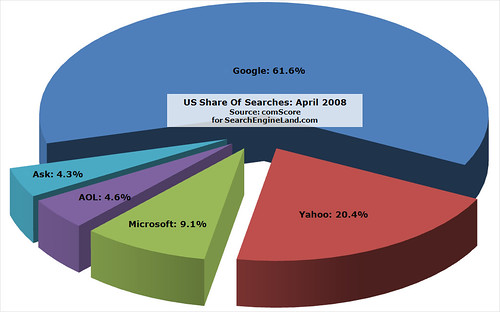
comScore April 2008 US Search Share

As with recent search stats from Hitwise and Nielsen, comScore's latest stats for April 2008 search engine share in the United States shows Google hitting a new high, breaking through the 60% mark for the first time with comScore's measurements.

Searches that happened on the five "core" search engines that comScore tracks stack up as follows:

  • Google: 61.6%
  • Yahoo: 20.4%
  • Microsoft: 9.1%
  • AOL: 4.6%
  • Ask: 4.3%

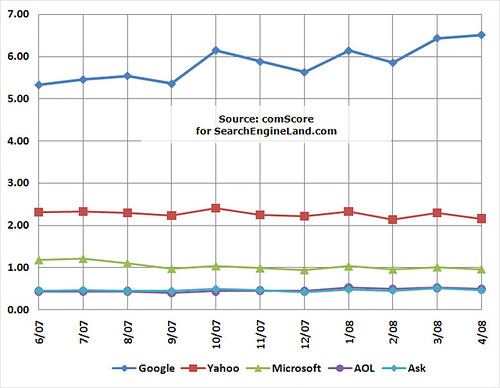
The trend over time? Here's data going back to June 2007 (I don't have previous months because comScore changed its methodology, and I don't have adjusted figures prior to that period):

comScore June 2007 - April 2008 US Search Share

As you can see, Google set a new high for the period. Yahoo and Microsoft continued hitting new lows from their previous lows last month.

How about number of searches versus market share?

  • Google: 6.5 billion
  • Yahoo: 2.2 billion
  • Microsoft: 961 million
  • AOL: 491 million
  • Ask: 458 million

The trend:

comScore June 2007 - April 2008 US Search Share

Sometimes a search engine like Yahoo or Microsoft can drop in share but still be stable in raw number of searches or even see an increase, due to the overall number of searches increasing. Not this month.

Caveat Time!

As a reminder, my general rules when evaluating popularity stats:

  • Avoid drawing conclusions based on month-to-month comparisons. Lots of things can cause one month's figures to be incomparable to another month. It's better to see the trend across multiple months in a row.
  • Avoid drawing conclusions based on one ratings service's figures. Each service has a unique methodology used to create popularity estimates. This means that ratings will rarely be the same between services. However, a trend that you see reflected across two or more services may give you faith in trusting that trend.
  • Consider Actual Number Of Searches: While share for a particular search engine might drop, the raw number of searches might still be going up (and thus they might be earning more money, despite a share drop). This is because the "pie" of searches keeps growing, so even a smaller slice of the pie might be more than a bigger slice in the past.

Google Content Partner Site Examples re-launched

More partner site examples from the Google content network

Our advertisers have often asked: 'What kinds of web sites make up the Google content network?'

To help answer this question, we just re-launched the Partners page on the Google content network microsite to include a more comprehensive set of examples of where your ads can appear. After all, the content network is comprised of hundreds of thousands of web sites, from information and news sites like About.com and the New York Times, to blogs like Ask the Builder. And while it's not possible to individually name all the sites in the content network, the revamped Partners page is meant to better demonstrate the variety of sites available. Below are some features of the new Partners page:
  • Sites are organized by category. This will help you browse sites by categories that represent your target audience, such as Finance, News, Entertainment, Technology, etc. For example, if you sell herbal teas, you might browse through the Health & Fitness or Home & Garden categories to see examples of related sites. Or, if your target demographic is female, you can try the Women's Interest category.
  • Once you find a site that's relevant to your product or service, you can use placement targeting to target your ads to that site directly. We recommend you use the Placement Tool to determine whether a specific site is available for targeting, and to identify other relevant placements to target. Further, if your campaign is already running on the content network, you can see the sites where your ad has appeared by running a Placement performance report.
  • For those of you targeting users in other countries, a drop-down menu lets you browse partner sites in countries in Europe, Asia, and Latin America.
(Click on the image for a full size version)

So while the simple question "Where will my ads appear?" may not be the simplest to answer, we hope the new Partners page will help you better understand the variety of sites available to you to help you meet your advertising objectives on the content network.

Mittwoch, 21. Mai 2008

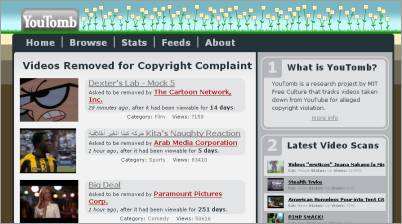
YouTomb Lists YouTube Removals

YouTomb is a research project by the MIT “that tracks videos taken down from [Google-owned] YouTube for alleged copyright violation,” as the site explains.

Nielsen: Google Hits New Search Share High

April 2008 Nielsen US Search Share

Another ratings service shows Google hitting an all-time high for search share in the United States. This is according to April 2008 search share stats from Nielsen Online that were released (PDF) today. Last week, Hitwise also reported Google hitting a new record. Microsoft also dips below the 10 percent mark for the first time.

Here are the percentage shares for the top five search engines shown in the pie chart above:

  • Google: 62.0%
  • Yahoo: 17.5%
  • Microsoft: 9.7%
  • AOL: 4.3%
  • Ask: 2.1%

Note that in the chart above, traffic from Ask.com-owned My Web Search is not combined by Nielsen with the Ask figure. If it were, the Ask figure would rise to 2.8 percent.

The trend over time? Here's data going back to November 2007 (data from previous periods doesn't compare because Nielsen changed its methodology):

April 2008 Nielsen US Search Share Trend

Google hit a new high, up from its previous high last month. Both Yahoo and Microsoft hit new lows after previous lows last month, but Microsoft's was more dramatic.

How about number of searches versus market share?

  • Google: 5.1 billion
  • Yahoo: 1.5 billion
  • Microsoft: 796 million
    AOL: 352 million
  • Ask: 172 million

The trend:

April 2008 Nielsen US Search Share

Caveat Time!

As a reminder, my general rules when evaluating popularity stats:

  • Avoid drawing conclusions based on month-to-month comparisons. Lots of things can cause one month's figures to be incomparable to another month. It's better to see the trend across multiple months in a row.
  • Avoid drawing conclusions based on one ratings service's figures. Each service has a unique methodology used to create popularity estimates. This means that ratings will rarely be the same between services. However, a trend that you see reflected across two or more services may give you faith in trusting that trend.
  • Consider Actual Number Of Searches: While share for a particular search engine might drop, the raw number of searches might still be going up (and thus they might be earning more money, despite a share drop). This is because the "pie" of searches keeps growing, so even a smaller slice of the pie might be more than a bigger slice in the past.
The Yahoo Search Marketing have released several minor updates to make the use of the search ad console easier for advertisers to work with. Here is a list of changes and enhancements made to the system:

* All names of objects (campaign, ad group, keyword, etc.) that are offline are displayed with red text for easy recognition.
* The "Top Campaigns" and “Watched Campaigns” tables on the Dashboard page now include a “Status” column to help you identify if and why any campaigns are offline.
* Minor updates to the "Campaigns" page have been made, including a new “Status” column, the ability to filter by “Status” when using the Advanced Search function, and replacing the “Campaign On/Off” button with individual “Pause” and “Unpause” buttons.
* We made minor tweaks to the Ads table on an Ad Group page, including adding a “Status” column, and replacing the “Campaign On/Off” button with individual “Pause” and “Unpause” buttons.
* New status settings have been added on the Search page, under the Campaigns tab.
* The addition of the “Status” column to the Ad Group, Ad and Keyword Search screens under the Campaigns tab.
* The ability to export (using the “Download” button) account information has been added to account-level Ad Group and Keyword pages, under the Campaigns tab.

-> Y!

What's New

Here are the latest features and enhancements to help you manage your ad campaigns.


Account Display Enhancements

Areas in which we made small enhancements to your account interface include:


Pricing Update

Our goal is to improve search users’ experience, while also improving the value of traffic to you. Last year, we launched several initiatives that have directly impacted the way we price the leads we provide you, including:

  • A new ranking model, based on both the ad’s quality—or relevance—and the bid amount.
  • Pricing discounts, which can discount your cost-per-click on clicks on our partners’ sites based on our assessment of the quality of traffic delivered by those sites.

Now, we've changed the way we set the minimum bid required to participate in a Sponsored Search keyword market. Previously, the minimum bid for any keyword in our system was $0.10. With this update, your minimum bid required to participate in a keyword market can be higher or lower than $0.10. The amount set as your minimum bid on a keyword can vary depending on multiple factors, such as the relevance of your keywords (as measured by the quality of the ads associated with them in an ad group), and the number of bidders and their bid amounts in the particular keyword market. Currently, Content Match minimum bids remain at $0.10

Dienstag, 20. Mai 2008

'neuer matchingtyp bei google: Automatic Matching (beta)

Automatic Matching (beta) nur für freigeschaltete beta-test accounts (zzt.)

Dear AdWords Advertiser,

On May 20, 2008, a checkbox will appear on your campaigns' 'Edit Campaign Settings' pages giving you access to an optional beta feature called 'automatic matching.' The feature will be enabled by default, although it won't begin to affect your account until June 3, 2008.

Please use this time to decide if you'd like to participate in the automatic matching beta. If you wouldn't, simply uncheck the box on the 'Edit Campaign Settings' page for each of your campaigns before June 3rd. Below you'll find more information about automatic matching and how to opt out, if you choose to do so.


I. About Automatic Matching

Automatic matching shows your ads on relevant search queries not already captured by your keywords. It works by analyzing the content of the landing pages, ads, and keywords in your ad group. It then shows your ads on search queries relevant to this information.
The system will continually monitor your performance on these queries and adjust its matches accordingly. Automatic matching aims to show your ads only on queries that yield a high clickthrough rate (CTR) and a cost-per-click (CPC) comparable to or lower than your ad group's current average CPC. This way, your ads receive additional targeted traffic at a similar cost to your current traffic.

Automatic matching won't affect the traffic you're currently receiving. In addition, automatic matching will have no impact if your campaigns already capture the majority of relevant traffic.

See a list of frequently asked questions about automatic matching at http://adwords.google.com/support/bin/topic.py?topic=13669&hl=en_US.


II. How to Opt Out
See full instructions for opting out at http://adwords.google.com/support/bin/answer.py?answer=86319&hl=en_US. Remember, you'll be able to opt out as early as May 20th, but the feature won't begin to affect your account until June 3rd.

If you have a large number of campaigns in your account and don't want to opt each one out of automatic matching, please reply to this email by May 29th stating that you don't wish to participate in this beta.

We're eager to hear your feedback once this feature has run in your account for a few weeks - just reply to this email with any comments or suggestions.

Thank you for advertising with us. We look forward to providing you with the best advertising service possible.

Sincerely,

Google Factory Tour of Search (webcast)

klickst du hier<-

Google is offering a live webcast of Factory Tour of Search press event to be held at its Mountain View, California headquarters today on Monday, May 19th, 9:30am – 12:00pm PDT.

Google will offer an insider’s perspective on Search and provide an update on Google Health. Speakers will include Product Management Directors R.J. Pittman, Carter Maslan, Johanna Wright, and VP of Search Products and User Experience, Marissa Mayer.

View the Live Webcast where you can choose between Windows media player or Real player (It resized my firefox window!). Keep tracking Google Podium, their press center where you can view a selection of public presentations made by Google executives.

Google Enables Third Party Tracking For Content Network

Google is accepting third-party advertising tags on the Google content network in North America. This will empower advertisers to work with approved third parties to serve and track display ads, including rich media ads, across the Google content network through AdWords, giving them more options, flexibility and control over their campaigns.

We had not accepted third-party tags in the past because we didn't have a process for reviewing ads to make sure that they comply with our format standards and policies, which were established to ensure that ads we serve provide the best possible user experience. Now that's in place.

Ad servers, rich media ad agencies and research firms can now go through a certification process that ensures the highest level of advertiser service and user experience. In fact, advertisers and agencies now have the ability to serve ads and measure performance through these certified third parties:
  • Advertiser ad servers: DoubleClick (DFA), Mediaplex
  • Rich media agencies: DoubleClick Rich Media, Eyeblaster, EyeWonder, Interpolls, PointRoll, Unicast
  • Research firms: Dynamic Logic, IAG Research, InsightExpress, Factor TG
We will be certifying more third-party partners in the future.

Advertisers and agencies will now be able to manage their Google content network campaigns with the same systems they use for other online campaigns, which is helpful for determining the effectiveness of their online advertising mix. Further, this new service gives advertisers and agencies more opportunities to increase their return on investment and reach new audiences in informed and creative ways. The response from those testing early versions of the program have been positive.

For publishers on the network, this program offers a way to expand their advertiser base and enable advertisers to better understand the value of their inventory, with the goal of increasing their overall revenue. And they'll be able to show more compelling display ads to their visitors, enhancing their web experience.


Google has announced that they will now support the ability for advertisers to track their ads using third party advertising tags. This new feature is only available within Google's content network (aka AdSense) and only available for North America based advertisers.

In the past, the only way to track your impression data was to trust Google's AdWords reports. Now, it appears you can use third party tags to track content network ad impressions and clicks. The supported and certified ad tracking tags include:

(1) Advertiser ad servers: DoubleClick (DFA), Mediaplex
(2) Rich media agencies: DoubleClick Rich Media, Eyeblaster, EyeWonder, Interpolls, PointRoll, Unicast
(3) Research firms: Dynamic Logic, IAG Research, InsightExpress, Factor TG

Google said they will be adding more over time. Google then explains the pros for advertisers and publishers:

Advertisers and agencies will now be able to manage their Google content network campaigns with the same systems they use for other online campaigns, which is helpful for determining the effectiveness of their online advertising mix. Further, this new service gives advertisers and agencies more opportunities to increase their return on investment and reach new audiences in informed and creative ways. The response from those testing early versions of the program have been positive.

For publishers on the network, this program offers a way to expand their advertiser base and enable advertisers to better understand the value of their inventory, with the goal of increasing their overall revenue. And they'll be able to show more compelling display ads to their visitors, enhancing their web experience.

Google Health: Die virtuelle Krankenakte ist online


lange in der Gerüchteküche und unerwartet live gegangen... die virtuelle Krankenakte

hier ersteinmal ein paar screenshoots weiter unten 'dem krasse AGB' ;)

Ich bin auf die Datenschützerschreie gespannt...


Screen captures of Google Health:


Google Health Screen Shots

Google Health Screen Shots

Google Health Screen Shots

Google Health Screen Shots

Google Health Screen Shots

Google Health Screen Shots

Google Health Screen Shots

Google Health Screen Shots

Google Health Screen Shots

Google Health Screen Shots

Google Health Screen Shots

Google Health Screen Shots

Google Health Screen Shots

Google Health Screen Shots

Google Health Screen Shots

Google Health Screen Shots

Google Health

Google Health Terms of Service

Welcome to Google Health.

1. Your Agreement with Google

Your use of Google Health is governed by this agreement. "Google" means Google Inc., located at 1600 Amphitheatre Parkway, Mountain View, CA 94043, United States, and its subsidiaries or affiliates involved in providing Google Health.

2. Not Medical Advice; U.S. Use Only

Google Health does not offer medical advice. Any content accessed through Google Health is for informational purposes only, and is not intended to cover all possible uses, directions, precautions, drug interactions, or adverse effects. This content should not be used during a medical emergency or for the diagnosis or treatment of any medical condition. Please consult your doctor or other qualified health care provider if you have any questions about a medical condition, or before taking any drug, changing your diet or commencing or discontinuing any course of treatment. Do not ignore or delay obtaining professional medical advice because of information accessed through Google Health. Call 911 or your doctor for all medical emergencies.

You may only use Google Health if you reside in the United States.

3. Your Account and Use of Google Health

You must provide accurate and complete registration information any time you register to use Google Health. You are responsible for the security of your passwords and for any use of your account. You must immediately notify Google of any unauthorized use of your password or account by following the instructions at this link: http://www.google.com/support/accounts/bin/answer.py?answer=48601.

Your use of Google Health and any content accessed through Google Health must comply with all applicable laws, regulations and ordinances, including any laws regarding the export of data or software. You must be at least 18 years old to use Google Health.

You may not access Google Health other than by the interfaces provided by Google or interfere with or disrupt the proper operation of Google Health.

4. Use of Your Information

If you create, transmit, or display health or other information while using Google Health, you may provide only information that you own or have the right to use. When you provide your information through Google Health, you give Google a license to use and distribute it in connection with Google Health and other Google services. However, Google may only use health information you provide as permitted by the Google Health Privacy Policy, your Sharing Authorization, and applicable law. Google is not a "covered entity" under the Health Insurance Portability and Accountability Act of 1996 and the regulations promulgated thereunder ("HIPAA"). As a result, HIPAA does not apply to the transmission of health information by Google to any third party.

5. Additional Terms

Your use of Google Health and any content accessed through Google Health is subject to each of the additional terms provided in connection with Google Health, including the Google Health Privacy Policy, the Sharing Authorization, and the Google Health Legal Notices.

6. Content and Services Accessed through Google Health

Google Health may include content that you find offensive, including health-related content that is sexually explicit.

Google may make third-party services available through Google Health. In order to use a specific service, you may choose to allow the third-party service provider to retrieve, provide, and/or modify health and other information in your account or otherwise share your information with the service provider. Once you enable a specific third-party service provider to access your account, the service provider may continue to access your account until you affirmatively disable access. Third-party service providers include both health care providers and other entities. It is your sole responsibility to review and approve each such third-party service before sharing your information through or otherwise accessing it.

Google may screen, modify, refuse, or remove certain content or third-party services, but is not responsible for and does not endorse any third-party content or services. Google further does not endorse any third-party service providers, other health care providers, products, services, opinions, or web sites accessed through Google Health.

USE OF THESE SERVICES AND RELIANCE ON THIS CONTENT IS SOLELY AT YOUR OWN RISK. GOOGLE MAY NOT BE HELD LIABLE FOR ANY DAMAGES ARISING OUT OF OR RELATED TO YOUR USE OF ANY THIRD-PARTY SERVICE OR CONTENT. Providers of these third-party services and/or content are Google's "Licensors".

7. Google Proprietary Rights

Google and its Licensors own all proprietary rights to Google Health. Google gives you a personal, revocable, non-assignable, and non-exclusive license to use Google Health.

8. Modification and Termination of Google Health

Google may place limits on, modify, suspend or terminate Google Health generally, and may suspend or terminate your use of Google Health if you fail to comply with this agreement. This suspension or termination may delete your information, files, and other previously available content. If Google terminates Google Health or your use of Google Health, this agreement will also terminate, but Sections 3, 5, 7, 8, and 10-13 shall continue to be effective after this agreement is terminated.

9. Changes to this Agreement

Google may change this agreement and will post the modified agreement at https://www.google.com/health/html/terms.html. If you do not agree to the modified agreement, you should stop using Google Health. Your continued use of Google Health after the date the modified agreement is posted will constitute your acceptance of the modified agreement.

10. Indemnification

You will defend or settle any third-party claim against Google, any third party Google Health feature providers, or any of Google's other licensors arising out of or related to your use of Google Health.

11. Exclusion of Warranties

NEITHER GOOGLE NOR ANY OF GOOGLE'S LICENSORS MAKE ANY EXPRESS WARRANTIES, AND EACH OF THEM DISCLAIMS ALL IMPLIED WARRANTIES, INCLUDING IMPLIED WARRANTIES OF ACCURACY, MERCHANTABILITY, FITNESS FOR A PARTICULAR PURPOSE, AND NON-INFRINGEMENT. NEITHER GOOGLE NOR ANY OF GOOGLE’S LICENSORS MAKE ANY WARRANTY THAT THE CONTENT IN GOOGLE HEALTH SATISFIES GOVERNMENT REGULATIONS REQUIRING DISCLOSURE IF INFORMATION ON PRESCRIPTION DRUG PRODUCTS. CONTENT IN GOOGLE HEALTH IS DEVELOPED FOR USE IN THE UNITED STATES, AND NEITHER GOOGLE NOR ANY OF GOOGLE’S LICENSORS MAKE ANY REPRESENTATION CONCERNING THE CONTENT WHEN USED IN ANY OTHER COUNTRY.

12. Limitation of Liability

NEITHER YOU NOR GOOGLE OR ANY OF ITS LICENSORS MAY BE HELD LIABLE UNDER THIS AGREEMENT FOR ANY DAMAGES OTHER THAN DIRECT DAMAGES, EVEN IF THE PARTY KNOWS OR SHOULD KNOW THAT OTHER DAMAGES ARE POSSIBLE OR THAT DIRECT DAMAGES ARE NOT A SATISFACTORY REMEDY. THE LIMITATIONS IN THIS SECTION APPLY TO YOU ONLY TO THE EXTENT THEY ARE LAWFUL IN YOUR JURISDICTION.

NEITHER YOU NOR GOOGLE OR ANY OF ITS LICENSORS MAY BE HELD LIABLE UNDER THIS AGREEMENT FOR MORE THAN $1,000.

The limitations of liability in this Section do not apply to breaches of intellectual property provisions or indemnification obligations.

13. General Legal Terms

If you have not signed a separate written agreement with Google related to Google Health, this agreement is the entire agreement between you and Google related to Google Health, replacing any prior agreements. If there is any conflict between this agreement and a signed written agreement between you and Google related to Google Health, the signed written agreement will control.

Google's Licensors may be third party beneficiaries to this agreement. There are no other third party beneficiaries to this agreement. The parties are independent contractors, and nothing in this agreement creates an agency, partnership, or joint venture.

If Google provides you with a translation of the English language version of this agreement, the English language version of this agreement will control if there is any conflict.

Failure to enforce any provision will not constitute a waiver of that provision. If any provision is found unenforceable, it and any related provisions will be interpreted to best accomplish the unenforceable provision's essential purpose.

This agreement is governed by California law, excluding California's choice-of-law rules. THE EXCLUSIVE VENUE FOR ANY DISPUTE RELATING TO THIS AGREEMENT IS SANTA CLARA COUNTY, CALIFORNIA. YOU AND GOOGLE CONSENT TO THE PERSONAL JURISDICTION OF THESE COURTS. Nothing in this agreement limits either party's ability to seek equitable relief.

April 28, 2008


und eine 2. Box:

Google Health Sharing Authorization

AUTHORIZATION

I hereby authorize Google to share the health information contained in my Google Health profile(s) in its entirety, to only those entities and individuals I designate, for the purpose of providing me with medical care and for the purpose of sharing my information with others that I choose.

I understand and agree that this authorization permits the disclosure of health or treatment information about me, to the entities and individuals I designate, that may also contain sensitive information relating to the following:

  • HIV or AIDS
  • Mental illness or any mental health condition
  • Alcohol or substance abuse
  • Sexually transmitted diseases
  • Pregnancy
  • Abortion or other family planning
  • Genetic tests or genetic diseases

I understand and agree that this authorization also covers any record that was created by a doctor or other health care provider other than the doctor or health care provider who supplied the record to Google Health.

This authorization will remain in effect and permit the ongoing disclosure by Google of information in the Google Health Service until I delete my profile(s) in the Google Health Service entirely or revoke the authorization. I may revoke this authorization at any time by using the features or options described in the Google Health FAQ. I understand that my revocation will not apply to actions Google has already taken in reliance on my prior authorization.

I understand and agree that in addition to the information I choose to share, Google may only share information in the limited circumstances described in the Google Health Privacy Policy.

I understand that I may request a copy of this authorization at any time.

April 28, 2008


und geauthed wird es jedoch schon auf deutsch ;)


Montag, 19. Mai 2008

Preisverfall für Display-Ads

Von März auf April sanken die Preise für Display-Ads in den USA um 23 Prozent, ermittelte der Technologieanbieter PubMatic.


Online-Publisher in den USA bekommen für ihre Werbeplätze immer weniger Geld. Das berichtet die "New York Times". Einer Studie des Technologieanbieters PubMatic zufolge sanken die Preise, die in Online-Werbenetzwerken für Bannerplätze bezahlt werden, von März bis April dieses Jahres um 23 Prozent - eine Folge der wirtschaftlichen Rezession im Land. Die sinkenden Preise können bei vielen Publishern offenbar auch nicht durch eine insgesamt gestiegene Nachfrage nach Online-Werbung kompensiert werden. Beim Online-Portal AOL brach der Umsatz mit Display-Ads im ersten Quartal 2008 gegenüber dem Vorjahresquartal um 19 Prozent ein. Konstante Preise indes verzeichnen die Suchmaschinenvermarketer, allen voran Google. Und selbst Yahoo überraschte die Analysten mit einem höchst positiven ersten Quartal und Umsätzen, die neun Prozent über denen des Vorjahres lagen.

Umsätze im Affiliate Marketing

Affilinet (aus der Internetworld)
Umsatz Q1 2006: 16,7 Mio. Euro
Umsatz Q1 2007: 17,7 Mio. Euro
Umsatz Q1 2008: 23,1 Mio. Euro

Tradedoubler (aus dem Q1 Report)
Transaction revenues Q1 2008: 59,94 Mio Euro (52,66 Mio. Euro)
Transaction gross profit Q1 2008: 12,76 Mio Euro (11,69 Mio. Euro)
7 Prozent gross profit aus Deutschland

Belboon (aus dem Geschäftsbericht)
Umsatz im Geschäftsjahr 2007: 1 Mio. Euro
(Belboon = AdButler-Übernahme)


(hmmm, fehlen noch zanox zahlen)

Microsoft schlägt Yahoo "Alternative zu Übernahme" vor

Seattle/New York (Reuters) - Microsoft lässt trotz seines gescheiterten Übernahmeversuchs bei Yahoonicht locker.

Das weltgrößte Softwareunternehmen schlug dem US-Internetkonzern am Sonntagabend eine Alternative zu einem vollständigen Kauf vor. Allerdings zeichnet sich ab, dass der Yahoo-Großaktionär Carl Icahn dabei nicht mitspielen dürfte. Vor zwei Wochen hatte Microsoft seine 47,5 Milliarden Dollar schwere Yahoo-Kaufofferte zurückgezogen.

Microsoft nannte keine Details seines neuen Vorstoßes. Der Konzern teilte lediglich mit, beide Firmen hätten eine Alternative besprochen, die eine "Transaktion mit Yahoo" umfasse, nicht aber einen vollständigen Kauf. Zugleich schloss Microsoft aber nicht aus, eventuell doch noch eine Offerte für eine Komplett-Übernahme auf den Tisch zu legen. Dies hänge davon ab, wie sich künftige Gespräche mit Yahoo entwickelten.

Icahn werde sich mit der abgespeckten Variante nicht zufrieden geben, sagte indes eine Person, die mit den Ansichten des Milliardärs vertraut ist. "Microsoft versucht, die Milch zu bekommen, ohne die Kuh zu kaufen." Auf so etwas habe sich Icahn noch nie eingelassen. "Er will nicht erleben, dass Yahoo in irgendeine Art Joint Venture mit Microsoft geschubst wird. Und er wird sich nicht benutzen lassen, um Yahoo in so etwas reinzuschubsen." Stattdessen werde Icahn nun wohl mehr darauf drängen, dass Yahoo eine Allianz mit dem Suchmaschinenbetreiber Google eingeht. Genau das geht aber gegen die Interessen von Microsoft, die mit dem Yahoo-Kauf Google angreifen wollten.

Yahoo reagierte mit seiner bekannten Position, weiterhin eine Reihe strategischer Alternativen zu prüfen und offen zu sein für alle "Transaktionen, die im besten Interesse unserer Aktionäre sind". Dazu gehörten auch Vorschläge von Microsoft. Man habe dem Softwarekonzern aber klar gemacht, derzeit nicht an einer vollständige Übernahme interessiert zu sein.

Yahoo hatte vor zwei Wochen selbst das aufgestockte Microsoft Angebot als zu niedrig abgelehnt. Daraufhin geriet das Yahoo-Management unter Druck einiger wichtiger Aktionäre. Insbesondere der Milliardär und Investor Icahn ereiferte sich über den Widerstand der Yahoo-Spitze. Er warf dem Management um Konzern-Chef Jerry Yang irrationales Verhalten vor und startete eine Kampagne zum Austausch des Führungsgremiums.

Twitter explodes, but does it matter?

Twitter is not a household name just yet, and while some think it has the potential to become a web giant along the lines of Facebook or MySpace, the microblogging site may be reaching the point where it needs to take off or else become just another Google application.

Twitter is in the midst of securing close to $20 million in funding, and traffic is eight times what it was a year ago, according to Hitwise. Comcast even has a customer service representative whose sole job is to monitor Twitter for complaints (subscription) about Comcast service. However, recent outages seem to signal that a big IPO isn't exactly right around the corner.

"To get the funding it needs for its tech upgrade, and perhaps an eventual stock offering, Twitter needs to make a viable business case. If it falls short, Twitter is more likely to wind up as an application in a larger Web company, such as Google," said Stephen Baker of Business Week.

Baker conducted a brief survey of Twitter users, asking whether it was a fad or a growing giant. Some responses labeled Twitter a blogosphere killer, while others said it was even easier for networking than Facebook. Twitter co-founder Biz Stone sees it as becoming an indispensable part of the internet. "It can become a communication utility, something people use every day," Stone said.

In Baker's opinion, however, Twitter's future rests in how long people are interested in writing 140 character tweets and keeping up with their friends.

"It's not the core technology, which is simple, but instead the community. Twitterers find and follow the people they care about on the service," he wrote.

comScore: Google ist erstmals die beliebteste Website der USA

Google hat in der Rangliste der in den USA meistbesuchten Websites bei den Marktforschern von Comscore erstmals die Führung übernommen. In der April-Tabelle steht Google mit 141,08 Millionen einzelnen Besuchern vor Yahoo mit 140,613 Millionen. Auf dem dritten Platz folgt Microsoft, das im April 121,213 Millionen Besucher auf seine Seite lockte. Die Daten werden nicht absolut ermittelt, Comscore rechnet sie aus einem Panel von Internetnutzer hoch.

Ähnlich verfahren auch die Marktforscher von Nielsen, die Google schon länger auf Platz 1 sehen. Laut ihrer April-Statistik (PDF-Datei) weist Google 128,188 Millionen einzelne Besucher auf, Yahoo, das hier nur auf Platz drei kommt, 117,065 Millionen und Microsoft 122,059 Millionen. In einer weiteren Tabelle führt Nielsen noch die einzelnen Marken der Unternehmen auf. Googles YouTube steht hier auf Platz 6 mit 72 Millionen einzelnen Besuchern. MSN/Windows Live kommt auf 93 Millionen Besucher.

Dem zunehmenden Besuch von Seiten des Videodienstes YouTube hat Google laut Comscore die Führung zu verdanken. Laut Nielsen ist im April ein durchschnittlicher US-amerikanischer Internetnutzer von Zuhause und von seinem Arbeitsplatz aus 59-mal ins Netz gegangen und hat dabei 104 Domains besucht. Nach Angaben von Comscore hat der Einsendeschluss für die Einkommenssteuererkläung am 15. April Webseiten, die für die Steuern relevant sind, einen erheblichen Zulauf gebracht. Die Besucherzahl der Steuerbehörde Internal Revenue Service wuchs beispielsweise um 35 Prozent auf 23,4 Millionen.

Hier die Besucher USA im April (comScore):
google.com: 141,08 Millionen
yahoo.com: 140,613 Millionen
microsoft.com: 121,213 Millionen

Besucher USA im April (Nielsen):
google.com: 128,188 Millionen
yahoo.com: 117,065 Millionen
microsoft.com: 122,059 Millionen

Girl Flashes Chest at Street View Car :)

It was inevitable. As people became aware of the Google Street View Camera Car, people were going to use it to get their five minutes of fame - now we have the girl who will forever be known as the first person to flash her chest at the Google Street View car.

Thankfully for her, the main event was not captured, proving that even the most shameless behaviour still requires good timing!

In the past, we have had more opportunity-grabbing clowns, such as those who have been caught relieving themselves, people who attempt to perform complex bicycle stunts, and the man who made himself famous for giving the Google crew the finger. Perhaps an extension of their new face blurring technology is needed to curb these miscreants?

Thanks: Streetviewfun

Freitag, 16. Mai 2008

Yahoo! SearchMonkey Now Open For Everyone

Today, Yahoo! is making its SearchMonkey developer platform publicly available and is kicking things off with a launch party and a developer challenge. As we noted a few weeks ago when SearchMonkey launched in private beta, Yahoo! is encouraging the use of microformats and semantic web standards by providing an infrastructure that developers can use to build applications (using the structured data from web sites). Specifically, developers can create two types of "enhanced listings" for web sites. Generally, searchers will have to opt-in to the enhanced listings for a particular site to see them in the search results.

If you're going to be in the Sunnyvale area tonight, RSVP for the launch party, which includes demos and"substantial amounts of food and beer". If you want to take part in the developer challenge, submit your SearchMonkey application by June 14th. Prizes will be awarded for Best Enhanced Result, Best Infobar, Most Innovative Use of Structured Data, Best Data Service, and Grand Prize (best over all categories).

http://searchengineland.com/080424-113600.php

http://developer.yahoo.com/searchmonkey/


Yahoo lässt den SearchMonkey los
Geschlossene Beta der offenen Suche gestartet

Im Februar 2008 kündigte Yahoo an, seine Suche zu öffnen und Websites die Möglichkeit zu geben, Einfluss auf die Suchergebnisse zu nehmen. Nun startet ein Beta-Test, an dem Entwickler und Webmaster teilnehmen können, um die Darstellung ihrer Seiten in den Suchergebnissen von Yahoo zu modifizieren.

SearchMonkey
Yahoo nennt seine neue Entwicklerplattform "SearchMonkey". Sie erlaubt es, über Webstandards und strukturierte Daten die Suchergebnisse mit zusätzlichen Informationen zu bestücken. Damit will Yahoo zugleich das semantische Web voranbringen, indem mit der eigenen Suche künftig eine in großem Umfang genutzte Applikation zur Verfügung steht, die semantische Merkmale nutzt. So hofft Yahoo, die Verbreitung von RDF und Mikroformaten durch deren Nutzung zu fördern.

Als Beispiel führt Yahoo die Profilseiten des Social-Network LinkedIn an, die Yahoo dank der Nutzung von Mikroformaten in seinen Suchergebnissen in einer kompakten Zusammenfassung anzeigen kann. Zudem kann Yahoo dadurch die Suchergebnisse verbessern, schließlich erlaubt dies der Suchmaschine, den Wohnort oder den aktuellen Arbeitgeber als solche zu erkennen. Auch Bilder und Links lassen sich so gezielt in die Suchergebnisse einbinden.

Ab sofort steht SearchMonkey in einer begrenzten Beta-Version zur Verfügung, für die sich Entwickler anmelden können.

Google Releases Google AdWords Editor 5.1 and Schedules Maintenance for May 17

Google has announced the release of AdWords Editor 5.1. This new version contains only minor adjustments, but would be quite beneficial for users.

AdWords Editor 5.1 update includes, the previous four tabs for advertisements (text, image, local business, and mobile) now been grouped under a single 'Ads' tab. This update has been incorporated due to a constant 'space issue' in the interface. However, this issue only bothered a handful of users. Well, it seems Google does recognize the importance of each and every user after all.

There are some posts on Webmaster World on the release of AdWords Editor 5.1. One of the most interesting post that caught my eye, stated:

“If you do upgrade, and you have comments on any of your campaigns, ad groups, keywords, ads, or anything, make sure you export them out first before you do your upgrade! I learned the hard way that upgrades wipe out comments.”

On the other hand, according to Search Engine Roundtable, Google AdWords has scheduled a system-wide maintenance on Saturday, May 17th 2008. The advertisements will be functioning, but the Application Programming Interface (API) will be shut down. So, do not get all worked up, if you do not see your API running. It would be up and running as soon as the maintenance is completed.

Online-Werbung: Die Mischung macht’s

Einer Case Study von Yahoo zufolge ist die Kombination von Display-Werbung und Suchmaschinenmarketing am erfolgreichsten.

Online-Kampagnen, die sowohl Display-Werbung als auch Suchmaschinenmarketing einsetzen, erzielen die beste Wirkung. Das ist das Ergebnis der aktuellen Studie "Yahoo! Close the Loop - Online-Werbesynergien" von Yahoo! Deutschland, dem Marktforschungsinstitut comScore und der Online-Mediaagentur Plan.Net. Am Beispiel der Online-Kampagne eines führenden Finanzdienstleisters wurden Wirkung und Synergie-Effekte von grafischer Werbung und Suchmaschinenmarketing untersucht. Bereits der alleinige Einsatz der Display-Kampagne konnte der Case Study zufolge erbrachte einen Anstieg der Nettwo-Reichweite der Kundenwebsite von über 200 Prozent. Bei den Suchanfragen suchten die Testpersonen sogar um mehr als 350 Prozent häufiger nach den Suchbegriffen der Kampagne, als die Personen ohne Display-Kontakt. Dieser Effekt setzt sich auch bei den Page Impressions und der Konversionsrate fort, so die Studie weiter.

Weit größere Effekte erzielte im Rahmen der Studie aber die Kombination aus Display-Werbung und Suchmaschinenmarketing.

Bei den Usern hingegen, die Kontakt zu sowohl Display- als auch Search-Kampagnen hatten, konnten die Performance-Ergebnisse nochmals entscheidend gesteigert werden. So erhöhte sich die Reichweite der Kunden-Website durch den Werbemix um mehr als das 15-fache. Ein Ähnliches Bild zeigte sich bei den Page Impressions: Bei Personen mit alleinigem Kontakt zur Display-Kampagne steigerten sich die PIs pro Nutzer auf 4 im Gegensatz zu 1,2 Page Impressions bei der Kontrollgruppe, die weder Kontakt mit der Display- noch mit der Suchmaschinenwerbung hatte. Testpersonen mit Kontakt zur Search- und Display-Kampagne, kamen dagegen auf 5,9 Page Impressions pro Nutzer. "Unsere aktuelle Studie belegt nicht nur die mittlerweile allgemein anerkannte Effizienz von Online-Werbung, sie beweist auch, wie die geschickte Kombination von Suchmaschinenmarketing und klassischer Display-Werbung einer Online-Kampagne den entscheidenden Kick zu einer besseren Performance geben kann", kommentiert Heiko Genzlinger, Commercial Director Yahoo! Deutschland.

Für die Studie "Yahoo! Close the Loop - Online-Werbesynergien", die in Deutschland, Frankreich, Großbritannien und Spanien durchgeführt wurde, wurden von September bis Oktober 2007 die Nutzungsdaten von 20.826 Personen allein in Deutschland im Panel von comScore untersucht. Die Studie ist bei Yahoo! Insights ( closetheloop@yahoo-inc.com )kostenlos erhältlich.

ComScore crowns new king

There's a new No. 1 property on the web, according to comScore, and for the first time it's Google.

The search leader finally surpassed Yahoo, according to comScore's measurement, which tracks total audience. Though Google has long been the web's search leader, it had trailed behind Yahoo in the audience department. However, sites like YouTube, Picasa and Gmail have finally put Google in the audience lead.

However, Google doesn't have much of a lead over rival Yahoo. The two companies are separated by about 466,000 total visitors.

But Jack Flanagan, comScore's executive vice president, told The Associated Press that Google's audience lead could create a "halo effect" that may boost the company's other products.

That halo effect could be just what the doctor ordered for YouTube. Despite a massive audience, Google hasn't found a way to monetize the site's traffic. But Google executives have made finding a business model for YouTube a top priority for this year, and the site has begun to release a slew of new products to court advertisers.

The comScore news comes one day after it was revealed that Google's search business is expected to surpass Microsoft's operating system business.

The Social Network Wars Begin In Earnest: Facebook Bans Google Friend Connect

Facebook is all about openness and data portability, as long as that doesn’t involve openness or portability of data, it seems.

Today they wrote a long 7 paragraph blog post to get a single point across: Facebook has banned Google’s Friend Connect access to the Facebook API:

Now that Google has launched Friend Connect, we’ve had a chance to evaluate the technology. We’ve found that it redistributes user information from Facebook to other developers without users’ knowledge, which doesn’t respect the privacy standards our users have come to expect and is a violation of our Terms of Service. Just as we’ve been forced to do for other applications that redistribute data in a way users might not expect or understand, we’ve had to suspend Friend Connect’s access to Facebook user information until it comes into compliance. We’ve reached out to Google several times about this issue, and hope to work with them to enable users to share their data exactly when and where they choose.

This of course has nothing to do with the fact that Facebook launched their own nearly identically named product called Facebook Connect three days before Google’s Friend Connect.

It’s not clear exactly what features of Friend Connect justified the ban, since it is so similar to what Facebook announced on Friday. Both products allow the export of profile and friend list data to third party websites.

In the last paragraph of the blog post, Facebook says they want to work with everyone: “We think MySpace’s Data Availability, Google Friend Connect, and Facebook Connect can be part of a great movement in the industry to give users a better and safer experience online, while respecting user privacy. We look forward to working with our developer community and everyone else in the industry to help all of our users take their information, and their privacy, with them wherever they go.” If that’s the case, this sure is an interesting start to a healthy working relationship with Google. Next up on the block list: MySpace and their Data Availability malware product, no doubt.

Thanks for the tip, Jesse.

Update: Facebook PR is pointing out Sections 2B(4), 2B(5) and 2A9(vi) of the Developer Terms of Service:

4) You may not store any Facebook Properties in any Data Repository which enables any third party (other than the Applicable Facebook User for such Facebook Properties) to access or share the Facebook Properties without our prior written consent.

5) You may not sell, resell, lease, redistribute, license, sublicense or transfer all or any portion of the Facebook Properties, or use or store any Facebook Properties for any purpose other than as specifically authorized herein.

You will not use Facebook Platform or any of your Facebook Platform Applications, and your Facebook Platform Application will not be designed…(vi) to request, collect, solicit or otherwise obtain access to usernames, passwords or other authentication credentials from any Facebook Users, or to proxy authentication credentials for any Facebook Users for the purposes of automating logins to the Facebook Site.

minimize
CrunchBase Information
Facebook
Facebook image
Website: facebook.com
Location: Palo Alto, California, United States
Founded: February 1, 2004
Funding: $493M

On February 4th, 2004 Mark Zuckerberg launched The Facebook, a social network that was at the time exclusively for Harvard students. It was a huge hit, in 2 weeks, half of the student body… Learn More
Google
Google image
Website: google.com
Location: Mountain View, California, United States
Founded: January 1, 1998
IPO: August 19, 2004

Google primarily provides search and advertising services, which together aim to organize and monetize the world’s information. In addition to its dominant search engine, it offers a plethora of tools and platforms including its more popular… Learn More
Information provided by CrunchBase


He Said, She Said In Google v. Facebook
Michael Arrington
38 comments »

More details on Facebook’s banning of Google Friend Connect from the Facebook API earlier today. I spoke with Facebook Chief Privacy Officer Chris Kelly and Google’s Director of Engineering David Glazer about the banning to get a fuller picture of the conflict.

Here’s an example of how Friend Connect (more details) works in practice. A third party site may want to add social elements to their service. They can integrate with Friend connect and allow users to sign in. Those users choose a social network where they keep their profile (Orkut, Hi5, GTalk and, until today, Facebook) and log in via the social network’s API. They then become “members” of the site, using Google’s terminology. If any of their friends from their social network also become members of that site, those friends are shown on the site and you can interact with them. To see it for yourself, click “log in” at the top of this sample site, IngridMichaelson.

Kelly says the issue comes down to the fact that Google Friend Connect users don’t have control over data pulled from Facebook. In particular, Facebook is concerned that they have no relationship to the end site where the data is presented (in the example above, IngridMichaelson). Instead, Google has inserted itself as a middleman in the process.

Also, Kelly says, once permission is granted to share data, the user has no way to revoke that permission from their Facebook account. Facebook has a privacy control panel that lets users set and change privacy setting over time, including the removal of applications. With Google in the middle, Facebook has no way to stop the flow of data to these third parties.

Google’s Glazer counters that they have a very effective method for unlinking to a site that a user has given permission to, so users will be just fine. In the screen shot below, Google gives an option to “Unlink” the specific social network from the site (on right) or change the data that’s shared from the social network (on left). Kelly is correct that you can’t trigger the unsubscribe from Facebook.com, but Glazer says that’s because Facebook’s API has no way of telling Facebook about the third party site the data has been passed off to.

Glazer says that they have been in “constant contact” with Facebook over the Friend Connect product, and are still trying to work with Facebook to get access to the API again. But Facebook has their own competing product to Friend Connect, called Facebook Connect. The longer the ban, made under the banner of protecting user privacy, remains in place, the stronger Facebook’s position will be competitively. My guess is they’re in no hurry to get through this conflict any time soon.

The fact is that Google is taking perfectly adequate steps to protect user privacy with their Friend Connect product, and it is a useful product for users. After talking with both sides, it seems to me that Facebook is relying on a very convenient catch-22 to stay out of Google’s network. They are the ones in control of their own API functionality, and they could add features that fix this problem. Until they do, there’s nothing Google can do to remedy the “problem,” and the walls around the Facebook garden get ever higher.

SEMPO 2007 State of Market Survey Data- A surprising Major Online Ad Spend Trend

Search Engine Marketing Professional Organization (SEMPO) conducted the SEMPO 2007 State of Market Survey, in which it found that about 80 % of the participating advertisers are more than willing to pay more for Behavioral Targeting. That in itself indicates towards a major shift in the Online Advertisement Spend Trend. The survey included the participation of 867 search engine advertisers and search engine marketing agencies

According to SEMPO, four out of five advertisers are not hesitant in increasing their online advertising budget to add behavioral targeting to their pay-per-click campaigns. Demographic targeting such as age and gender also saw a lot of willing takers, amounting to 57% of advertisers who were ready to spend more. On an average, advertisers are ready to increase their budget spending by 11% for both behavioral and demographic targeting. However, the actual investment in behavioral targeting is far lower than the interest shown in this field by the advertisers. 40% of the participants stated that as of now they aren't targeting or retargeting searchers, but they have been planning to do so in the next 12 months

Dayparting also showed a lot less interest by the advertisers. According to the survey, only 30% advertisers are interested in increasing their bids based on dayparting. In addition, 9% of advertisers confessed that the budget spending depended on their comfort levels.

According to Kevin Lee (Member SEMPO Board of Directors), “The next best thing to an impression or click from a search result is the ability to serve a highly relevant and targeted graphical or textual ad to a consumer while they are still very interested in their search. Online advertisers are always faced with the challenge that there is a finite number of searches occurring daily. Behavioral targeting gives advertisers an opportunity to expand the search marketing universe.”

This new developing trend in Online Advertisement Spending indicates a change of strategies by advertisers and will also compel online marketing companies to make some changes to their strategies as well.

web-bubble 2.0: Das große Start-up-Sterben hat begonnen

Wenn Businesspläne radikal geändert (Plazes), Auslandsexpansionen gestoppt (Joost) und die Venture Capitalists die Anschlussfinanzierungen verweigern, dann sollten die Alarmglocken klingen: Das große Start-up-Sterben im Web 2.0 hat offenbar begonnen. Zumindest drängte sich dieser Eindruck auf der next 08 in Hamburg auf. In Amerika und Großbritannien ist es schon deutlich zu sehen, in Deutschland berichten viele Insider von sehr unangenehmen Gesprächen der Gründer mit den VCs, die sehr kritisch nach der Erfüllung der Businesspläne fragen und am Ende ihr Geld lieber in der Tasche lassen. Viele Start-ups, die noch eine Anschubfinanzierung bekommen haben und nun in die zweite Finanzierungsrunde gehen, werden wohl nicht weitermachen können. Zumal in Deutschland die Szene, die mit ihrem Geld die Start-up-Szene finanziert hat, sehr klein ist. Veröffentlicht Freitag, 16. Mai 2008 00:08 von FAZ-ht

Donnerstag, 15. Mai 2008

Google Analytics data lost

Google hands out a system message in analytics which says they lost some data between april and may.

See screenshot:


Sieben Tage Datenverlust bei Google Analytics

Bei einigen Usern von Google Analytics sind die Daten vom 30. April bis 5. Mai verloren gegangen. Jetzt soll ein Großteil davon wiederhergestellt worden sein.

Nutzer des kostenlosen Webtrackingtools Google Analytics werden derzeit innerhalb ihres Accounts darauf hingewiesen, dass es Anfang Mai zu einer technischen Panne kam. Zwischen dem 30. April und dem 5. Mai litt Google Analytics unter verzögerten Datenübermittlungen, wodurch es in Einzelfällen auch zu kompletten Datenverlusten kam, meldet das Unternehmen. Die gute Nachricht sei: Fast alle Daten seien inzwischen wiederhergestellt und würden am 15. Mai in das System eingespielt werden. Die schlechte: Insbesondere im Bereich E-Commerce-Tracking gingen einige Daten komplett verloren. Doch, so versichert Google, beträfe dies nur einen kleinen Prozentanteil an Daten.

Google & Other Search Engines Dominate Traffic Drivers To Wikipedia

When writing about Powerset this week, I covered how its hopes to gain Wikipedia users was complicated by the fact that Wikipedia itself gets so many people from search, rather than direct navigation. New stats (PDF) from Nielsen Online reaffirm this -- four of the five top referring sites to Wikipedia are search engines, with Google by far the leader.

Here's the rundown on top referring sites that generate home users from the US, for April 2008:

Site Percent
Google
www.google.com
61%
Yahoo Search
search.yahoo.com
19%
Wikipedia
www.wikipedia.org
11%
MSN Search
search.msn.com
5%
AOL Search
aolsearch.aol.com
3%

To explain further, the chart above shows that 61 percent of people who were referred to Wikipedia in some way came from Google. And top sites that generate work users:

Site Percent
Google
www.google.com
66%
Yahoo Search
search.yahoo.com
16%
Wikipedia
www.wikipedia.org
9%
MSN Search
search.msn.com
6%
AOL Search
aolsearch.aol.com
4%

All that traffic Google sends to Wikipedia is one reason that many suspect Google would like to have its own Wikipedia alternative. Google Knol - Google's Play To Aggregate Knowledge Pages covers more about this, though that particular project has yet to happen.

Hitwise: Google Again Hits New High; Microsoft & Yahoo Again New Lows

Hitwise: April 2008 US Search Share

Hitwise released the latest statistics for search engine share in the United States for April 2008. Google has again hit a new high, jumping up 0.65% from the prior month's high, to 68% of the US search market. Microsoft and Yahoo hit all-time lows -- though Yahoo, at least, only drops by 0.1% further from its low last month. Microsoft dropped about 0.4%. Highs are based on data going back to August 2006.

The four major search engines stack up as follows:

  • Google: 67.9%
  • Yahoo: 20.3% (unrounded, 20.28%)
  • Microsoft: 6.3% (unrounded, 6.26%)
  • Ask: 4.2% (unrounded, 4.17%)

The trend over time? Here's the past year's worth of data:

Hitwise: April 2007-2008 US Search Share

Caveat Time!

As a reminder, my general rules when evaluating popularity stats:

  • Avoid drawing conclusions based on month-to-month comparisons. Lots of things can cause one month's figures to be incomparable to another month. It's better to see the trend across multiple months in a row.
  • Avoid drawing conclusions based on one ratings service's figures. Each service has a unique methodology used to create popularity estimates. This means that ratings will rarely be the same between services. However, a trend that you see reflected across two or more services may give you faith in trusting that trend.
  • Consider Actual Number Of Searches: While share for a particular search engine might drop, the raw number of searches might still be going up (and thus they might be earning more money, despite a share drop). This is because the "pie" of searches keeps growing, so even a smaller slice of the pie might be more than a bigger slice in the past. See Nielsen NetRatings: August 2007 Search Share Puts Google On Top, Microsoft Holding Gains for a further explanation of this.

Also specifically for Hitwise, you don't see AOL on the chart because Hitwise doesn't break it out. Instead, it is included in the "Other" figure. Hitwise generally undercounts AOL's share; other services put it at 4 percent or higher.

Mozilla sammelt Nutzerdaten

Der Firefox- und Thunderbird-Betreiber will das Nutzungsverhalten seiner Internet-Surfer analysieren.

Mozilla will mehr über die Internet-User erfahren und sammelt ab sofort im Rahmen eine Projekts Daten über das Nutzungsverhalten von Surfern. Das bestätigt Mozilla-CEO John Lilly in seinem Weblog. Über die Daten zur Verbreitung und den Update-Status des Webbrowsers Firefox hinaus sollen so Informationen über genauere User-Verhaltensweisen gesammelt werden. Details zu dem noch namenlosen Projekt gab Lilly nicht preis – der Schutz der Privatsphäre solle aber eingehalten werden, da die Nutzer selbst entscheiden können, welche ihrer Daten weitergeleitet werden.